

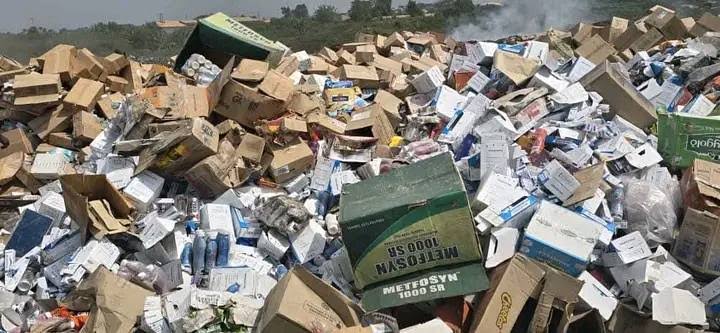
NAFDAC has disposed of expired medicines and medical consumables valued at about N59 million in Rivers State after the products were intercepted at the NPA Area 1 Port in Port Harcourt.
The consignment, which originated from the United States, arrived through the Nigeria Ports Authority Area 1 facility in Port Harcourt. NAFDAC officials, working jointly with the Nigeria Customs Service, discovered the products before they could be distributed for use.
The disposal was carried out on Monday at the Igwuruta dump site situated along the Eneka–Igwuruta Road in Obio/Akpor Local Government Area of the state.
Addressing participants at the exercise, the agency’s Director for the South-South zone, Chukwuma Oligbu, said the destruction was part of measures aimed at preventing unsafe pharmaceutical products from reaching the public.
According to him, NAFDAC, under its Director-General, Prof. Mojisola Adeyeye, remains focused on ensuring that medicines supplied within the country are suitable for consumption and comply with established safety and quality requirements.
He explained that pharmaceutical donations are particularly valuable to disadvantaged communities and people who have limited access to healthcare services.
However, Oligbu said such assistance could become a public health concern once the products exceed their shelf life or are determined to be unsuitable for treatment.
“However, when such products become expired or otherwise unsuitable for use, it is imperative that they are promptly removed from circulation and safely destroyed.
“They include antidepressants, anti-ulcers, analgesics, hypertension drugs and consumables,” Oligbu stated.
He said the shipment was prevented from proceeding into the distribution chain after NAFDAC officers stationed at the port identified the products during their inspection activities.
“These expired donated drugs were shipped into the country from the United States through NPA Area 1 Port, Port Harcourt, before they were flagged by eagle-eyed NAFDAC inspectors at the Port in collaboration with Customs officials.
“The drugs worth about ₦59 million were put on hold until their subsequent destruction. It further demonstrates our collective resolve to prevent the diversion, misuse and unauthorised distribution of expired, substandard or otherwise unfit medical products.
“The presence of expired medicines within the supply chain poses significant risks to public health. Their potential re-entry into circulation can result in misuse, diversion or inappropriate administration, while also undermining public confidence in our healthcare system.”
Oligbu further pointed out that the South-South region requires close regulatory attention because of its role in maritime trade and the concentration of commercial and healthcare activities across the area.
As regulators, he said NAFDAC recognises that the South-South geopolitical zone occupies a strategic position in Nigeria, saying, “The zone is home to important seaports, commercial centres, healthcare institutions and extensive trade activities.
“These unique characteristics make effective regulatory surveillance, enforcement and inter-agency collaboration particularly important.”
He assured that the agency would maintain and expand its monitoring operations across the region, covering inspections, product surveillance, enforcement, awareness programmes and engagement with relevant stakeholders.
The NAFDAC director also acknowledged the contribution of the Nigeria Customs Service, other government institutions, development organisations and stakeholders whose cooperation supported the successful exercise.
“Together, through sustained cooperation and responsible regulatory practices, we can strengthen Nigeria’s pharmaceutical supply chain and protect the health of our people.”