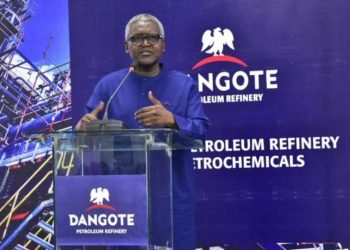
President of the Dangote Group, Alhaji Aliko Dangote, has reiterated his claim that Nigeria’s oil mafia is more powerful and deeply entrenched than international drug cartels, citing massive crude oil theft that has severely affected the country’s economy and operations of local refineries, including the $20bn Dangote Petroleum Refinery. Dangote made the assertion while speaking on the scale of crude oil losses and the challenges confronting Nigeria’s oil and gas sector.
According to Dangote, crude oil theft remains one of the biggest threats to Nigeria’s economic stability, with about 82 million barrels of crude reportedly stolen over a period, representing losses running into billions of dollars. He stressed that the sophistication, organisation, and protection enjoyed by oil thieves indicate the presence of a powerful network that cuts across multiple layers of society.
The billionaire industrialist argued that crude oil theft in Nigeria is not the work of small criminal gangs operating in isolation but a well-coordinated enterprise involving influential individuals. He said the ease with which large volumes of crude are stolen, transported, and sold in the international market suggests complicity within the system, including those who should ordinarily safeguard national assets.
Dangote explained that oil theft has had direct consequences on local refining efforts, particularly the Dangote Refinery in Lekki, Lagos. He disclosed that despite the refinery’s massive capacity and readiness to process crude locally, securing consistent crude oil supply has been a major challenge due to theft and pipeline vandalism. According to him, this undermines Nigeria’s long-standing goal of achieving energy security and reducing dependence on imported petroleum products.
He noted that the 82 million barrels reportedly lost could have been refined locally, saving Nigeria huge foreign exchange spent on fuel imports and boosting government revenue. Dangote added that the scale of the theft reflects systemic failure and weak enforcement, insisting that without decisive action, local refineries would continue to struggle despite heavy investments.
The business mogul further stated that the oil mafia operates with a level of influence that makes it difficult for law enforcement agencies to tackle the menace effectively. He compared their operations to global drug cartels, arguing that in Nigeria’s case, oil thieves appear even more powerful due to their access to infrastructure, intelligence, and international networks for illegal crude sales.
Dangote called on the Federal Government to take stronger and more coordinated action to dismantle oil theft networks, stressing that addressing the problem requires political will, transparency, and accountability. He said efforts must go beyond arresting low-level operators and focus on identifying and prosecuting the real masterminds behind the illegal trade.
Industry analysts have long warned that crude oil theft is one of the major reasons Nigeria struggles to meet its OPEC production quota. Reports estimate that hundreds of thousands of barrels are lost daily to theft, pipeline vandalism, and illegal refining, depriving the government of critical revenue needed for infrastructure, healthcare, and education.
Dangote also highlighted the impact of oil theft on investor confidence, noting that persistent losses discourage both local and foreign investors from committing capital to Nigeria’s energy sector. He warned that unless the issue is decisively tackled, the country risks missing opportunities to fully harness the benefits of its vast hydrocarbon resources.
The Federal Government has previously acknowledged the scale of crude oil theft and announced several measures, including the deployment of security forces and surveillance technology to protect oil assets. However, despite these efforts, theft remains rampant, raising questions about the effectiveness of current strategies.
Some stakeholders have argued that addressing oil theft requires reforms in pipeline monitoring, improved community engagement in oil-producing areas, and stricter penalties for offenders. Others have called for better tracking of crude oil production and exports to close loopholes exploited by criminal networks.
Dangote’s comments have reignited public debate on the true extent of oil theft in Nigeria and the forces behind it. Many Nigerians believe that without confronting powerful interests benefitting from the illegal trade, the country will continue to lose billions of dollars annually while ordinary citizens bear the economic consequences.
As Nigeria pushes to revive its oil and gas sector and maximise the benefits of local refining, Dangote insisted that defeating the oil mafia is crucial. He maintained that crude oil theft is not just a criminal issue but a national security and economic emergency that must be addressed urgently to secure the country’s future.

Presidential Fleet Gulps N4.24bn in 6Months
Fresh disclosures from GovSpend, a platform that tracks public spending, show that no less than N4.24bn was released for the...