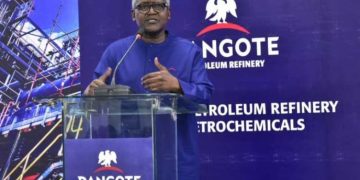


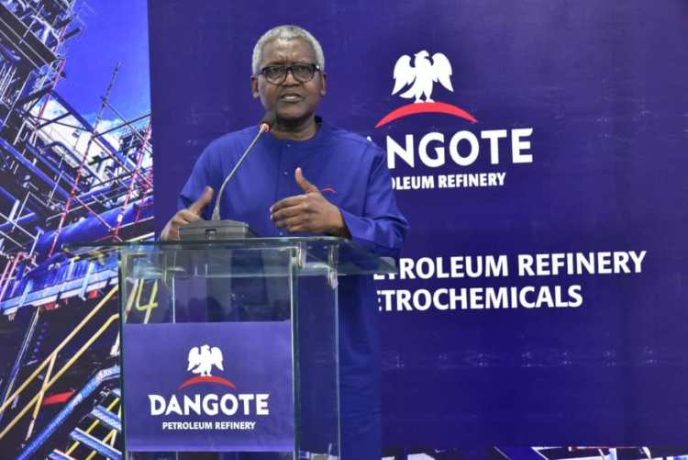
President of the Dangote Group, Aliko Dangote, has revealed that the company turned down attempts by the Nigerian National Petroleum Company Limited (NNPC) to increase its stake in the Dangote Petroleum Refinery beyond the current 7.25 per cent ownership.
Dangote disclosed this during an interview with Nicolai Tangen, Chief Executive Officer of the Norwegian Sovereign Wealth Fund. According to him, the decision was made because the group intends to list the refinery publicly in the future, allowing more Nigerians to own shares in the project instead of concentrating ownership in one institution.
The refinery, located in Lekki and valued at about $20bn, has continued to strengthen its role in Nigeria’s petroleum sector. Data reviewed from the Nigerian Midstream and Downstream Petroleum Regulatory Authority showed that local refinery petrol supply rose significantly in the first quarter of 2026, reaching 3.18 billion litres, while fuel imports dropped sharply to 965.52 million litres.
Industry figures indicate that the Dangote refinery remains the only refinery in Nigeria currently producing Premium Motor Spirit on a commercial scale. Reports also showed that the refinery supplied petrol at an average ex-depot price of around ₦1,000 per litre between January and March 2026, translating to more than ₦3.2tn worth of fuel supplied locally during the period.
Dangote explained that although the original agreement with the NNPC was for a 20 per cent stake, the national oil company failed to complete payment for the remaining shares before the deadline expired. The company eventually settled at 7.25 per cent ownership after declining to exercise the option to acquire the remaining stake.
Speaking on challenges facing businesses, Dangote identified government policy inconsistency as one of the biggest risks to investments. He noted that despite NNPC’s interest in acquiring more shares in the refinery, the company preferred broader ownership participation by Nigerians.
He also stated that future investors in Dangote businesses, including the refinery, fertiliser and petrochemical plants, would receive dividends in dollars due to the group’s strong export earnings. According to him, about 80 per cent of the company’s revenue is expected to come from exports.
Dangote further shared how he sold his properties in the United States and the United Kingdom to focus fully on building industries in Nigeria. He said the move allowed him to dedicate his time and energy to achieving long-term business goals.
On financing the refinery project, Dangote acknowledged support from several financial institutions, including Afreximbank, Africa Finance Corporation, Zenith Bank, Access Bank, UBA, Standard Bank of South Africa and Standard Chartered Bank.
Meanwhile, official data revealed a major shift in Nigeria’s fuel supply structure. In the first quarter of 2025, imported petrol exceeded locally refined supply. However, by the first quarter of 2026, domestic refining accounted for over 76 per cent of total petrol supply, highlighting the growing impact of local refining capacity on reducing fuel imports.