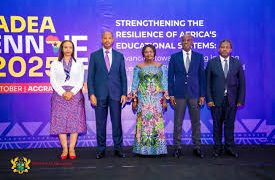


The Government of Ghana has expressed its readiness to form new partnerships aimed at transforming foundational learning across the country, with a focus on curriculum reform, teacher development, educational technology integration, and data-driven policymaking.
Minister of Education Haruna Iddrisu announced this on Wednesday, October 29, 2025, during the 2025 Triennale on Education and Training of the Association for the Development of Education in Africa (ADEA), currently taking place in Accra.
He said the initiative is part of Ghana’s commitment to strengthening early education and ensuring that every child gains essential literacy, numeracy, and digital skills.
“The transformation will emphasize curriculum review, teacher and school leadership development, the integration of educational technology, and the creation of strong evidence-based monitoring systems to support informed decision-making,” the minister stated.
Mr. Iddrisu reaffirmed that the government views foundational learning as a priority investment area, describing Ghana’s ambition to become a continental leader in digitally supported early education.
“Ghana remains committed to building strong partnerships in foundational learning, as we position our country as a champion in digital-indexed foundational learning delivery in Africa,” he added.
He noted that the Ministry of Education continues to strengthen basic education through initiatives supported by the Ghana Education Trust Fund (GETFund).
The minister said discussions at the three-day ADEA Triennale — covering education financing, school leadership, teacher professional development, and government-led resource mobilization — align closely with Ghana’s education priorities.
“These issues, particularly foundational learning, resonate deeply with our national education agenda and aspirations,” he told delegates, encouraging participants to share innovative practices and reflect on lessons learned from previous ADEA action plans.
Also addressing the gathering, Prof. Gaspard Banyankimbona, the African Union Commissioner for Education, Science, Technology and Innovation, highlighted ADEA’s role as a trusted continental institution leading evidence-based education reforms across Africa.
He unveiled a new Science, Technology, and Innovation Strategy for Africa, describing it as a forward-looking framework designed to foster inclusive, future-ready education systems.
“These guiding policies challenge us to bridge the school-to-labour market gap, integrate green and digital skills, and ensure that no one — especially girls, people with disabilities, or those in conflict-affected and climate-vulnerable regions — is left behind,” he said.
In his remarks, ADEA Executive Secretary Albert Nsengiyumva emphasized that strong leadership remains central to achieving lasting education reform.
“There are many critical issues before us — but above all, we must raise the standard of leadership in our respective countries, because leadership matters,” Nsengiyumva said.
The 2025 ADEA Triennale continues in Accra, bringing together education ministers, policymakers, and development partners from across the continent to discuss pathways for transforming Africa’s education systems.