

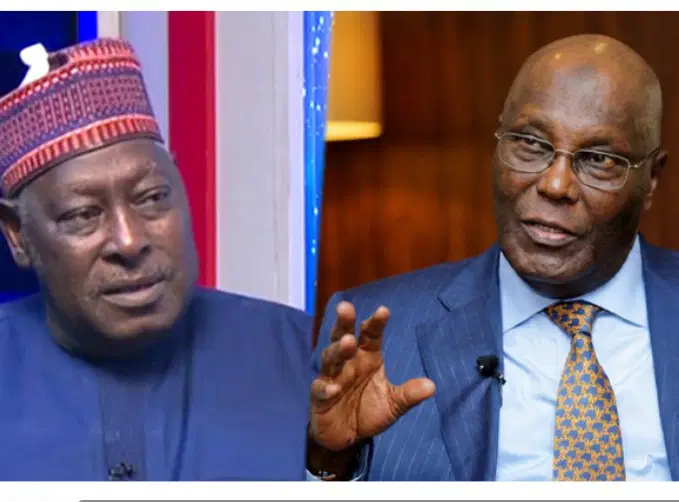
ABUJA — Former Secretary to the Government of the Federation (SGF), Babachir Lawal, has formally withdrawn his membership from the African Democratic Congress (ADC), launching strong criticisms against the party’s leadership and its presidential flagbearer, Atiku Abubakar, over alleged irregularities in the party’s selection process.
Lawal stated that he could no longer remain in a political platform he believes has deviated from its core principles, adding that supporting Atiku’s presidential ambition would, in his opinion, effectively secure President Bola Tinubu’s return to office in 2027. He argued that the opposition movement had lost credibility due to what he described as internal contradictions and disputed primary elections.
His departure drew an immediate response from Atiku Abubakar, who rejected Lawal’s claims and accused him of being dissatisfied simply because the outcome of the presidential primary did not favour his preferred contender.
Lawal, however, maintained that his exit was driven by serious concerns over what he described as manipulation and lack of transparency during the ADC presidential primary. He alleged that the exercise was structured to favour Atiku and his associates from the outset.
In a detailed statement, the former ADC North-East zonal chairman accused the party hierarchy of ignoring reports of malpractice during the selection process. He claimed that in several instances, votes were allegedly altered and official results adjusted to reflect predetermined outcomes.
He further asserted that individuals who emerged victorious in legitimate voting processes were reportedly replaced with candidates aligned with powerful blocs within the party, describing the entire exercise as distorted and unfair.
According to Lawal, these developments convinced him that the ADC had strayed from its original purpose of serving as a genuine democratic alternative for Nigerians. He said the internal conduct of the party reflected a pattern of control and imposition rather than fair competition.
He also said his resignation was necessary to avoid being associated with what he termed unethical political engineering ahead of the 2027 general elections. Remaining in the party, he argued, would imply endorsement of practices he strongly opposed.
Lawal went further to accuse Atiku’s political network of promoting divisive tendencies based on ethnicity and religion, warning that such an approach could worsen national unity if not addressed.
He also questioned Atiku’s suitability for national leadership, expressing disappointment that some northern political figures continued to support him despite persistent economic hardship and security challenges across the region.
Lawal argued that the northern region should prioritize leadership focused on addressing poverty, insecurity, and underdevelopment rather than repeating what he described as failed political choices.
He concluded by warning that continued internal disputes and disputed selection processes could further weaken opposition parties, stressing that public trust cannot be sustained where transparency and fairness are lacking.