

A former employee of the Abuja Electricity Distribution Company, Isaac Zegbe, has been arrested by the Nigeria Security and Civil Defence Corps over the alleged removal of electricity cables worth more than N350 million.
Zegbe, 25, was picked up alongside other suspected members of a cable theft network during operations conducted by the Commandant General’s Special Intelligence Squad across seven states.
The operations covered the Federal Capital Territory, Nasarawa, Plateau, Kogi, Benue, Niger and Kaduna.
The suspects allegedly targeted aluminium conductors along the Yangoji-Abaji route in Kwali Area Council of the FCT, with more than 15 kilometres of the cables said to have been removed from the installation.
The NSCDC National Public Relations Officer, Assistant Commandant Babawale Afolabi, announced the development on Monday during a parade at the Corps’ headquarters in Abuja.
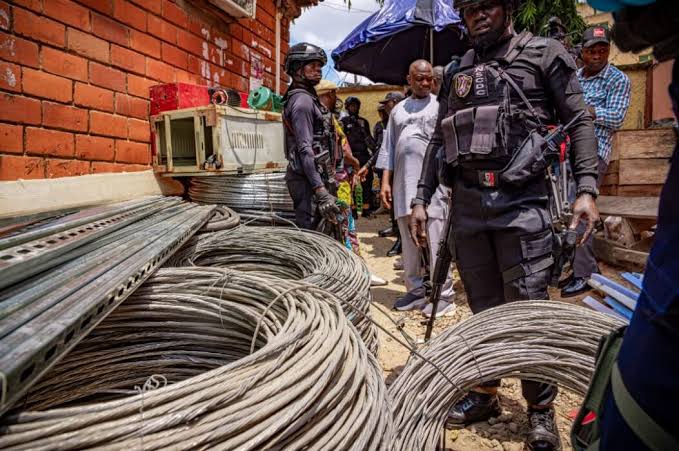
He also took journalists to Yangoji, where the alleged vandalism took place.
He said, “As part of ongoing operational successes to safeguard Critical National Assets and Infrastructure and eradicate crime, the Nigeria Security and Civil Defence Corps has arrested Isaac Zegbe, 25, a former employee of the Abuja Electricity Distribution Company, alongside his accomplices, who vandalised over 15 kilometres of aluminium conductors running from Yangoji to Abaji, valued at over N350m.”
Investigators subsequently traced part of the stolen materials to Gudu Market, where an operation led to the recovery of a large quantity of the cables.
The exercise also resulted in the arrest of suspected buyers, including Chijoke Christian, who was accused of purchasing the materials despite knowing that they were stolen.
Authorities have since obtained a court order to close the shops of traders allegedly connected to the purchase and distribution of the vandalised conductors.
“The stolen cables were subsequently distributed to marketers across several FCT markets. Following a targeted sting operation, NSCDC operatives recovered a significant volume of vandalised electrical cables at Gudu Market and arrested suspected receivers, including Chijoke Christian, who confessed to knowingly purchasing the stolen cables. The Corps has secured a court order to seal off the shops of all merchants linked to buying stolen aluminium cables”, Afolabi said.
The cable operation was one of several cases highlighted by the NSCDC as part of its recent intelligence-driven activities against criminal networks.
In a separate case, the Special Intelligence Squad reportedly uncovered a group accused of stealing Toyota vehicles within Abuja and surrounding states.
Adamu Yusuf, Hassan Bukar, Adamu Musa, alias Yellow, and Abdulsalam Isa, alias Kada, were arrested in connection with the alleged vehicle theft operation.
Four other suspects — Nuhu Ndam, Ponbin Lamkur, Yilcwat Sohdan and Ganpyal Dul — were also taken into custody over their alleged involvement in armed robbery.
An AK-47 bearing serial number 3152097, 16 rounds of 7.62x39mm ammunition and N70,000 were recovered during the operation.
The Corps also announced the recovery of Micaiah Nana, who was described as the last of 16 children allegedly trafficked by Archibong Anderson on January 15, 2026.
Those accused of purchasing the child have also been arrested and are assisting investigators, the NSCDC said.
Elsewhere, Bilyaminu Musa and Abba Yusuf were arrested over the alleged vandalism of electricity cables in central Abuja.
The NSCDC also linked Theophilus Oche Oboii to the alleged theft of 15 tractor batteries belonging to the National Agricultural Seeds Council in Kwali.
The batteries were allegedly disposed of at N20,000 each.
Other recoveries from the different operations included a Toyota Camry with registration number YAB 163 EE, cut armoured cables, 15 tractor batteries, master keys, cutting implements, knives and a travel bag containing clothes.
Afolabi said the Corps would continue to pursue individuals involved in attacks on critical national infrastructure and other criminal activities.
He said, “All suspects will be formally charged in court upon the conclusion of investigations and the establishment of a prima facie case against them.”