

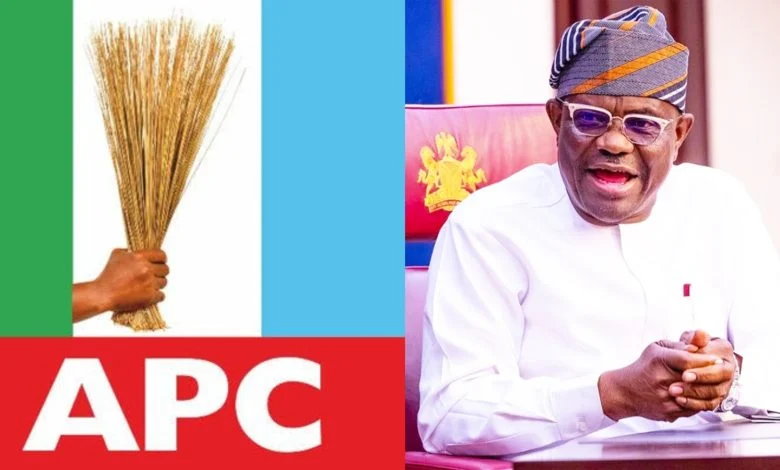
Governors elected on the platform of the All Progressives Congress (APC) have rejected political arrangements they believe could weaken the party ahead of the 2027 general elections.
The position follows growing tension over the political activities of Federal Capital Territory Minister Nyesom Wike, who has been promoting a cross-party “Rainbow Coalition” in support of President Bola Tinubu’s re-election bid.
The APC governors maintained that their political commitment remains with the party and its candidates at all levels. They also warned against the creation of parallel structures that could undermine the APC’s electoral machinery.
The governors’ position has brought renewed attention to the growing disagreement between Wike and some influential APC governors, particularly over how the coalition could affect contests for governorship, National Assembly and state assembly positions.
Wike has consistently argued that politicians do not necessarily have to join the APC to support Tinubu’s presidential bid. His coalition brings together politicians from different parties who support the President while retaining their individual political platforms.
However, some APC leaders have expressed concern that such an arrangement could create divided loyalties during the 2027 elections.
The major concern is that politicians campaigning for Tinubu at the presidential level could simultaneously support candidates from other parties in legislative or governorship elections.
APC figures opposed to the arrangement argue that such a voting pattern could weaken the party’s candidates even if Tinubu secures another presidential mandate.
The issue has also generated tension in states where politicians associated with Wike’s political network are challenging APC candidates.
Wike recently accused some APC governors, including Imo State Governor Hope Uzodimma and Kwara State Governor AbdulRahman AbdulRazaq, of working against his political activities. He nevertheless reaffirmed his support for Tinubu’s re-election.
The FCT minister has maintained that his disagreements with some APC governors should not be interpreted as opposition to the President.
He has argued that his objective is to build a broader political arrangement capable of supporting Tinubu in 2027, while allowing politicians to pursue their own ambitions under their respective parties.
The position has, however, raised questions about whether the coalition could strengthen Tinubu’s national support base or create additional challenges for the APC’s candidates at other levels.
In Rivers State, the coalition has become particularly prominent, with Governor Siminalayi Fubara publicly declaring support for the arrangement and backing Kingsley Chinda as the coalition’s preferred governorship candidate.
The developments have intensified debate within the APC over party discipline, political alliances and the need to maintain a unified campaign structure ahead of the elections.
For the APC governors, maintaining a single political structure remains important to protecting the interests of the party and its candidates.
Wike’s supporters, however, maintain that the Rainbow Coalition can expand Tinubu’s support beyond the APC and bring politicians from different political backgrounds into a common presidential campaign.
As the 2027 elections draw closer, the disagreement is likely to remain a significant issue within the ruling party, particularly in states where coalition-backed candidates are expected to compete directly with APC candidates.
The APC leadership may therefore face increasing pressure to balance the President’s broader political alliances with the interests of the party’s candidates across the country.