

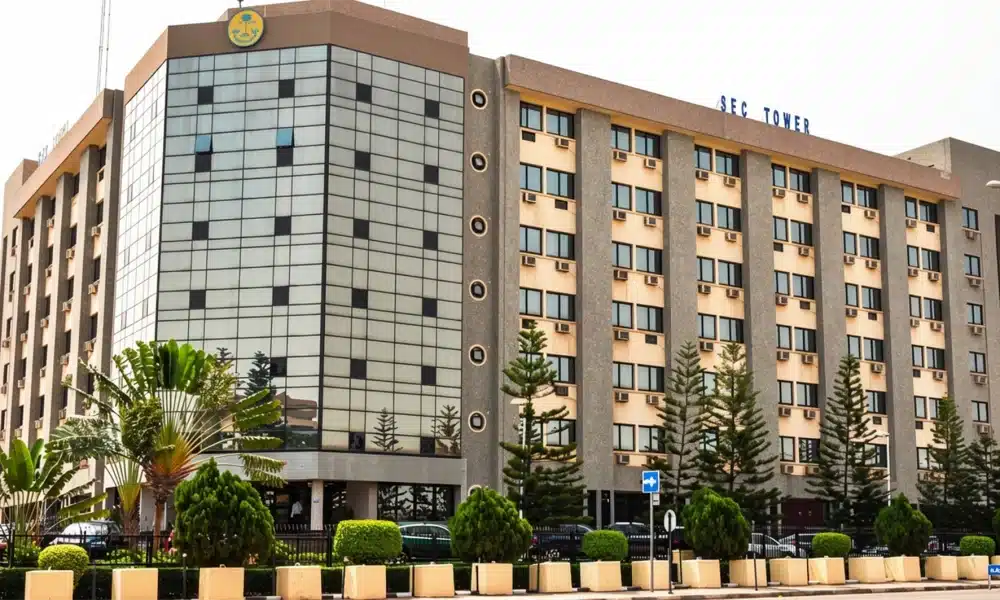
The Securities and Exchange Commission (SEC) has ordered companies operating within Nigeria’s capital market to place an immediate hold on the money, property and other financial resources connected to six people and three businesses recently identified by the Nigeria Sanctions Committee as terrorism financiers.
The instruction was issued in a Friday circular addressed to Capital Market Regulated Entities. The commission said the measure was taken under the Terrorism Prevention and Prohibition Act 2022.
Those affected are Babangida Muhammed Adamu Hammajam, Abdullahi Umar Usman, Ibrahim Abubakar, Adamu Chiroma, Muktar Muhammad Adamu and Yakubu Ogirima Ibrahim.
The businesses named are Nine to Nine BDC Ltd, Generation Currency BDC Ltd and Abbal Bako & Sons Bureau de Change.
The SEC said Hammajam was added to the sanctions register on June 18, 2026, following allegations that he helped finance terrorism and supported the Islamic State West Africa Province (ISWAP).
Usman was accused of using a series of financial transactions to provide assistance to a prohibited terrorist group. Abubakar was also designated over alleged involvement in financing terrorism and belonging to ISWAP.
Chiroma, according to the commission, allegedly relied on Bureau de Change activities and connected companies to facilitate the movement of money associated with terrorist operations.
The regulator said Muktar Muhammad Adamu was placed on the list on June 15, 2026, for allegedly assisting the financial structure supporting ISWAP’s Okene cell. Ibrahim was accused of supplying financial and other forms of support to the group’s Kogi cell.
The three BDC companies were similarly associated with alleged money movements connected to the Okene-based financing network.
The SEC’s move is part of the government’s wider campaign to cut off sources of funding available to armed extremist groups across the North-East and North-Central zones.
Financial regulators have continued to pay close attention to Bureau de Change businesses because of concerns surrounding unauthorised currency transactions, money laundering and the possible movement of illicit funds.
The country’s sanctions and counter-terrorism framework requires financial-sector businesses to take immediate action when individuals or organisations are placed under official sanctions.
Consequently, the SEC has told regulated firms to trace and lock down any relevant holdings without first alerting the affected parties. Details of the action taken, including assets placed under restriction and attempted transactions, must be forwarded to the Nigeria Sanctions Committee.
Firms have also been instructed to submit reports on suspicious financial activity to the Nigerian Financial Intelligence Unit for investigation and analysis.
The commission clarified that even when a customer’s name corresponds with an individual or organisation on the sanctions register, the transaction must be reported as suspicious. This applies to transactions carried out both before and after the sanctions notification reaches the institution.
The SEC further barred regulated operators from maintaining commercial dealings with the listed parties and ordered continued surveillance of their accounts and activities.
It warned that the directive is effective immediately and that firms that disregard it could face disciplinary measures under the Investments and Securities Act 2025 and relevant SEC rules on anti-money laundering and countering terrorism financing.
Possible penalties include substantial monetary fines, temporary shutdown of operations and cancellation of regulatory licences.