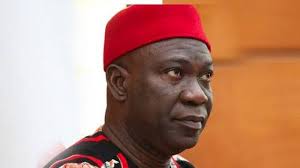


London — The United Kingdom has firmly rejected a high-level Nigerian government request to transfer former Deputy Senate President Ike Ekweremadu back to Nigeria to complete his prison sentence, citing concerns about justice enforcement and the severity of his crimes.
Last week, President Bola Tinubu deployed a heavyweight delegation to London in an attempt to secure either Ekweremadu’s early release or his transfer to a Nigerian prison. The team, led by Foreign Minister Yusuf Tuggar and Attorney General Lateef Fagbemi, met with UK Ministry of Justice officials to make the case for the 63-year-old politician.
The British government’s response was unequivocal. Officials expressed serious doubts that Nigeria could guarantee Ekweremadu would actually serve out his sentence if returned home. A UK government spokesperson emphasized that prisoner transfers are handled at complete governmental discretion and must serve the interests of justice.
“The UK will not tolerate modern slavery and any offender will face the full force of UK law,” a source close to the matter stated, underlining the seriousness with which British authorities view the case.
Ekweremadu’s situation stems from a shocking organ trafficking scheme that made legal history in Britain. In March 2023, he was convicted alongside his wife Beatrice and a medical doctor, Obinna Obeta, of conspiring to exploit a vulnerable young Nigerian man for his kidney. This marked the first conviction under the UK’s Modern Slavery Act for organ trafficking.
The former senator received a sentence of nine years and eight months. Dr. Obeta was handed 10 years, while Beatrice Ekweremadu received four years and six months. She has since been released and returned to Nigeria after serving half her term.
The plot emerged from a family crisis. Sonia Ekweremadu, the couple’s daughter, suffered from a deteriorating kidney condition that forced her to leave university and undergo regular dialysis. Medical advice suggested finding an unrelated donor due to hereditary kidney problems in the family.
What followed was a calculated exploitation of poverty. Dr. Obeta identified David Nwamini, a 21-year-old street trader from a Lagos village, as a potential victim. Nwamini lived in desperate circumstances—the eldest of seven siblings in a home without electricity or running water, selling mobile phone accessories from a wheelbarrow for as little as 50 pence a day.
He was lured with promises of work and opportunity in the United Kingdom, something he had dreamed of but never imagined possible. Instead, he was trafficked to London in February 2022 with falsified documents claiming he was Sonia’s cousin and a willing donor for an £80,000 transplant procedure.
When Nwamini was taken to the Royal Free Hospital’s private renal unit, consultant Peter Dupont raised immediate concerns. He refused to authorize the transplant, believing the young man didn’t understand the risks and suspecting financial coercion. Despite these red flags and evidence of document fraud, hospital staff failed to alert police—a safeguarding failure that has since drawn significant criticism.
The scheme began to unravel when the Ekweremadus attempted to return Nwamini to Nigeria after the transplant was rejected. Expecting the promised job or education opportunities, he instead faced deportation. In desperation, he fled to Staines police station, where body camera footage captured him distressed and disoriented, barely able to explain his situation in halting English. He falsely claimed to be 15 years old to secure immediate protection.
The investigation revealed disturbing details. While Ekweremadu had paid approximately £7,000 for Nwamini’s participation, the victim received only about £450—Dr. Obeta had pocketed the difference. Prosecutors described how the conspirators treated potential donors as “disposable assets—spare parts for reward.”
The trial also exposed evidence that Dr. Obeta himself had received a kidney transplant at the same hospital in July 2021 from another man allegedly trafficked from Nigeria, suggesting a broader pattern of exploitation.
The contrast between the Ekweremadus and their victim was stark. Investigators linked the family to several million pounds worth of properties in north London, Cambridge, and central London. Their children attended expensive British private schools. When Ekweremadu attempted to plead poverty during his testimony, the prosecutor dismissed it outright: “Senator, you cannot plead poverty.”
Judge Jeremy Johnson described Ekweremadu as the “driving force” behind the scheme and called his conviction “a very substantial fall from grace” for the prominent politician and lawyer.
David Nwamini’s victim impact statement revealed his continuing fear. He expressed worry for his safety in Nigeria, believing “those people can do anything” and that they “could arrest me or kill me.” He disclosed that someone had visited his father in Nigeria attempting to pressure him into dropping the case.
Despite his ordeal, Nwamini refused to claim compensation, believing money from “bad people” would bring “cursed and bad luck.” He now hopes to work, pursue education, and play football in the UK.
The Nigerian government’s intervention on Ekweremadu’s behalf has sparked sharp criticism domestically. Questions have been raised about why high-level officials were mobilized for a convicted criminal while more than 230 other Nigerians imprisoned in Britain receive no similar advocacy. The episode has intensified concerns about preferential treatment for Nigeria’s political elite.
Judge Johnson emphasized important lessons from the case, noting that medical professionals must remain vigilant to trafficking risks and report concerns when they arise. The failure of Royal Free Hospital staff to alert authorities despite clear warning signs has highlighted serious gaps in healthcare safeguarding procedures.
The case stands as a watershed moment in British legal history—the first successful organ trafficking prosecution under modern slavery legislation—and a stark reminder of how desperation, wealth disparity, and exploitation can intersect with devastating consequences.
Ekweremadu remains in a UK prison, where he will continue serving his sentence. The British government’s decision sends a clear message that human trafficking offenses will not be treated leniently, regardless of the perpetrator’s status or political connections.