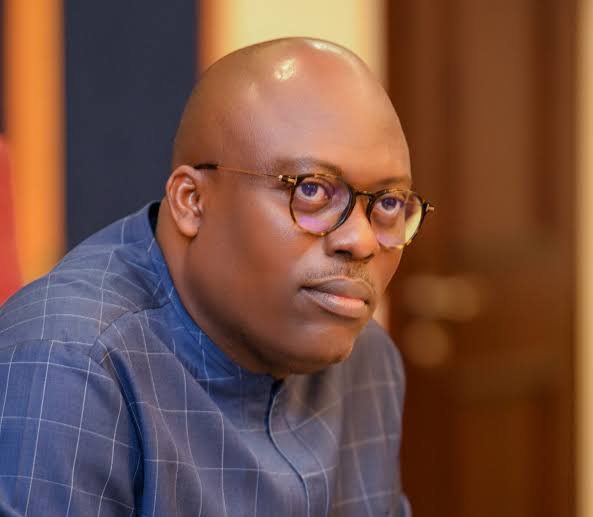
The All Progressives Congress (APC) has shed light on why Rivers State Governor Siminalayi Fubara has not yet been given a formal public reception since joining the party.
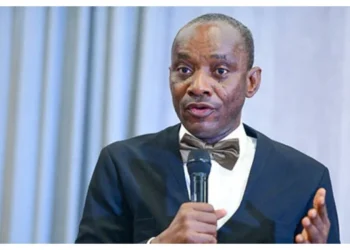
In an interview aired on TVC on Sunday, APC National Chairman, Professor Nentawe Yilwatda, said the party is deliberately staggering its activities for political and cultural reasons, with particular attention to developments in the northern region.
He explained that the party arranged its schedule to first handle events in the North before moving to the South, citing the approaching Ramadan period and the need to respect religious and community considerations.
Giving details, he said, “We have Kano we’re preparing for. When you’re dealing in politics, we opted to clear the north first because Ramadan is coming and most of the people in the north are Muslims.
“We have a lot of communities in the north that are sensitive to the issue of Ramadan. So we pleaded that we clear the northern governors who have to come to the APC first before going to the south, where we don’t have Ramadan as an issue.”
He maintained that the postponement should not be interpreted as a sign that Fubara lacks influence or standing within the party.
“So these are strategies and also acknowledge the sensitivity of each community. That’s the reason we took that decision. It has nothing to do with Siminalayi Fubara not having authority,” he added.
Reacting to claims that the governor may be struggling to take charge as APC leader in Rivers State, Yilwatda dismissed the suggestion and asked for proof of any dissatisfaction within the party.
“Is that what you’re told? I’m the national chairman. Who complained to you? What petition? I want you to give me one petition. Has he complained to you?”
When the interviewer referred to remarks by the Minister of the Federal Capital Territory, Nyesom Wike, about political stakeholders in Rivers aligning with President Bola Tinubu’s ‘Renewed Hope’ agenda, the APC chairman clarified that such alliances operate independently of the party’s official structure.
“Support groups are separate from party activities. Is it under the office of the chairman of the party?” he said.
Concerns about Fubara’s position stem from the protracted political turmoil in Rivers State. His alliance with former governor Wike broke down after a fierce power tussle that followed the 2023 elections, a crisis that eventually led President Tinubu to impose a six-month state of emergency in the state.
Fubara formally switched from the Peoples Democratic Party (PDP) to the APC on December 9, 2025, a move widely interpreted as part of his strategy to reinforce his political base ahead of the 2027 governorship contest and regain momentum after his rift with Wike.
Despite the defection, Wike — who continues to wield considerable political influence in Rivers even outside the APC — has argued that joining the party does not automatically place Fubara in charge of its state structure. He insists that real authority depends on control of grassroots networks and party machinery, much of which remains aligned with his supporters.
The situation has deepened political tensions in the state, as rival camps within both the APC and PDP continue consultations, power negotiations, and efforts to steady the political landscape ahead of the 2027 elections.