

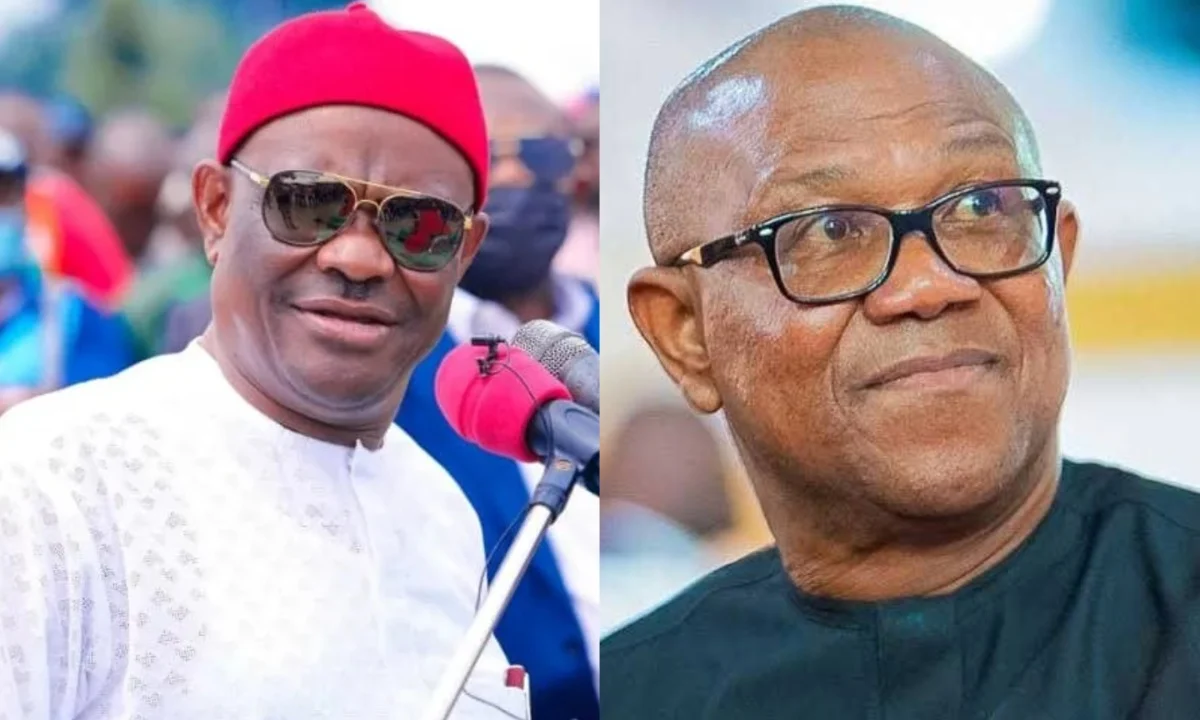
Minister of the Federal Capital Territory, Nyesom Wike, has shed more light on the political calculations that prevented Labour Party presidential candidate Peter Obi from carrying Rivers State during the 2023 general elections.
Wike spoke on Monday while appearing on TVC News, where he discussed the role played by the former G-5 governors in shaping the outcome of the presidential contest across the South-South region.
The former Rivers governor explained that the group had developed a political strategy aimed at limiting the chances of the Peoples Democratic Party’s presidential candidate, Atiku Abubakar, in the region.
According to him, the PDP had considerable influence across the South-South, making the region an important area for Atiku’s campaign. He said the G-5 therefore decided that allowing Obi to gain votes in some states would prevent Atiku from securing the level of support he might otherwise have received.
Wike explained that the arrangement was different in Rivers State because the group had specific political concerns about an Obi victory in the state.
He said the former governors agreed that while Obi could make significant gains in other parts of the region, Rivers would remain an exception.
The FCT minister stated that the group believed an Obi victory in Rivers would have produced a political signal that they did not want to see.
Wike said the decision was consequently taken to stop the Labour Party candidate from securing the state.
He also argued that the political situation that existed during the 2023 election has changed considerably ahead of the 2027 polls.
The minister maintained that Obi would not be able to replicate his previous performance across the South-South region under the present political circumstances.
The G-5 was formed by five PDP governors who opposed aspects of the party’s preparations for the 2023 presidential election. The bloc consisted of Wike, Oyo State Governor Seyi Makinde, former Benue State Governor Samuel Ortom, former Abia State Governor Okezie Ikpeazu and former Enugu State Governor Ifeanyi Ugwuanyi.
The group had demanded greater balance within the PDP leadership and expressed opposition to Atiku’s presidential bid.
Wike said their disagreements with the party’s leadership influenced the political decisions they made during the election period.
He further explained that the strategy was intended to weaken Atiku’s prospects rather than provide a blanket advantage to the Labour Party across the region.
His remarks also touched on Obi’s claim that he won Rivers State in the 2023 presidential election.
Wike disputed the claim, maintaining that the official outcome of an election is determined by the results formally declared by the Independent National Electoral Commission.
The minister argued that claims based on figures from selected polling units or social media platforms cannot replace the results announced by the electoral commission.
Obi, who contested the 2023 presidential election on the Labour Party platform, emerged as a major political force in several parts of southern Nigeria, recording notable support in the South-East and parts of the South-South.
Wike’s latest remarks have renewed attention on the role of the G-5 governors in the 2023 presidential contest and their decision to oppose Atiku in several political calculations ahead of the election.
With the 2027 elections approaching, the minister has also suggested that the political dynamics that influenced the previous election should not be assumed to remain unchanged.
His comments have further highlighted the political divisions within the PDP and the strategic decisions taken by its senior members during the 2023 presidential race.