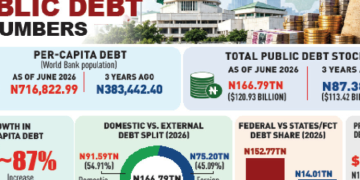


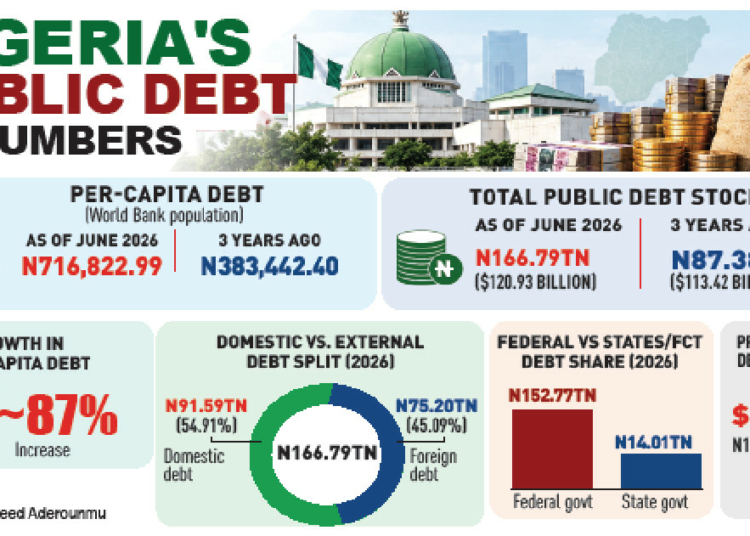
Nigeria’s public debt burden has continued to rise, with fresh calculations showing that the country’s estimated debt per person has increased to N716,822, up from N383,442 three years ago.
The figure represents an increase of approximately 87 per cent and was calculated by dividing Nigeria’s total public debt stock by the country’s estimated population for the respective periods.
According to the figures, the increase highlights the growing size of Nigeria’s public debt burden and has renewed concerns over the country’s ability to sustain its borrowing and meet rising debt-servicing obligations.
Debt Burden Rises Sharply
At the end of June 2023, Nigeria’s total public debt stood at N87.38 trillion, according to figures from the Debt Management Office (DMO).
Using the World Bank’s population estimate of 227,882,945 for 2023, the debt translated to approximately N383,442 per Nigerian.
Three years later, the estimated debt burden per person has risen to N716,822.
The increase means that the amount of public debt attributable to each Nigerian, based on the calculation, has risen by more than N333,000 over the three-year period.
The per-capita figure does not mean that individual Nigerians personally owe that amount to creditors. Rather, it is a statistical measure obtained by dividing the country’s aggregate public debt by the estimated population.
Growing Concerns Over Debt Sustainability
The development has intensified discussions about Nigeria’s debt sustainability, particularly as the government continues to face substantial obligations relating to debt servicing.
Economists and fiscal policy analysts have raised concerns about the pace at which public borrowing has increased relative to the country’s revenue-generating capacity.
Debt servicing has become a major component of government expenditure, placing additional pressure on public finances and limiting the resources available for other government priorities.
Nigeria is projected to spend more than $11.6 billion on debt servicing in 2026, representing a significant increase compared with the previous year.
The rising debt burden is also being assessed against Nigerians’ income levels, with the latest per-capita debt figure representing a substantially larger share of average income than it did three years ago.
From N87.38 Trillion in 2023
The June 2023 figure is significant because it was the first public debt position published after President Bola Tinubu assumed office in May of that year.
At the time, the DMO reported total public debt of N87.38 trillion.
With the population estimated at 227.88 million, the calculation produced a per-capita debt burden of approximately N383,442.
The latest figure of N716,822 therefore reflects not only an increase in the government’s aggregate debt obligations but also the effect of changes in Nigeria’s population and the value of the naira.
The figures have consequently renewed debate over how much additional borrowing the government can undertake without placing greater pressure on future public finances.
As Nigeria’s debt stock and debt-servicing obligations continue to attract scrutiny, the key issue remains whether government borrowing can generate sufficient economic returns and revenue to meet the obligations without further constraining public spending.