

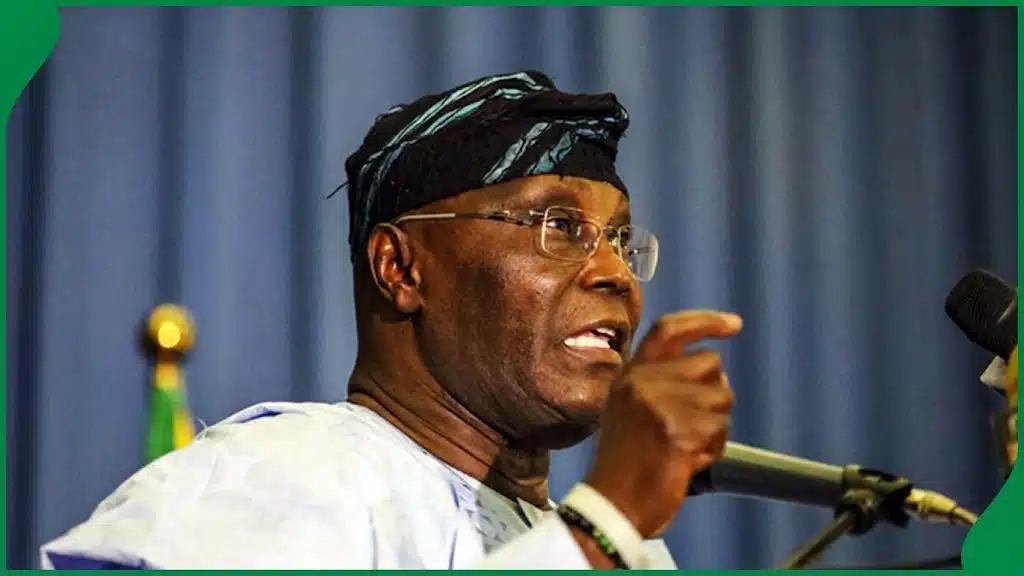
The presidential flagbearer of the African Democratic Congress (ADC), Atiku Abubakar, has challenged the recent declaration by the Oba of Lagos, Rilwan Akiolu, that there would be no opening for a change of leadership at the Presidential Villa in 2027.
Atiku maintained that the authority to determine Nigeria’s next president rests with citizens who will participate in the election and not with traditional institutions or political organisations.
The former vice president was responding to comments attributed to the Lagos monarch during a meeting with members of the All Progressives Congress (APC) campaign structure.
The delegation, headed by Abdulaziz Yari, Director-General of the APC presidential campaign council, visited the traditional ruler at his Lagos residence.
During the engagement, Akiolu expressed support for President Bola Tinubu’s aspiration to secure another term in office. The monarch reportedly declared that the presidency would remain occupied for the next five years, implying continued control of the seat by the incumbent.
Atiku, however, disagreed with the assertion, arguing that no traditional ruler possesses the constitutional authority to predetermine the outcome of a presidential contest involving millions of Nigerians.
His response was conveyed through a post on X by Phrank Shaibu, his Senior Special Assistant on Public Communication.
Atiku said Nigerians would ultimately decide whether Tinubu retains the presidency or another contender takes over after the 2027 election.
He also rejected any suggestion that a royal endorsement could settle the outcome of the forthcoming presidential contest before voters have had the opportunity to cast their ballots.
In his reaction, the ADC candidate reminded the monarch that the Presidential Villa is a national institution and cannot be treated as the private domain of any traditional ruler.
He argued that Nigeria’s presidency is an elective office governed by constitutional procedures rather than a traditional throne that can be assigned through royal authority.
Atiku further maintained that an endorsement from the Lagos monarch could represent his personal preference but could not legitimately be presented as the collective position of Nigeria’s population.
According to him, the electorate remains the ultimate decision-maker in a democratic system, with voters expected to determine who receives the mandate to govern the country.
He also drew attention to the economic and security difficulties facing citizens, arguing that many Nigerians are currently struggling with food shortages, insecurity and increasing living expenses.
Atiku suggested that people affected by these challenges are more concerned about the direction of the country than political endorsements made by influential individuals.
He stressed that the 2027 election should therefore remain open until Nigerians have made their choices at the polling stations.
The former vice president also emphasised the distinction between traditional authority and democratic governance, arguing that political power in Nigeria is transferred through elections rather than succession or coronation.
He said traditional rulers are entitled to personal political preferences, but such preferences cannot replace the constitutional right of citizens to select their leaders.
Atiku’s comments come as political activities and preparations for the 2027 presidential election continue to gather momentum, with major political figures and groups already positioning themselves ahead of the contest.
The ADC candidate maintained that no individual, irrespective of social status or traditional position, can declare the presidential race concluded before Nigerians have voted.
He reiterated that the final decision on who occupies Aso Rock after the next election belongs exclusively to the Nigerian electorate.