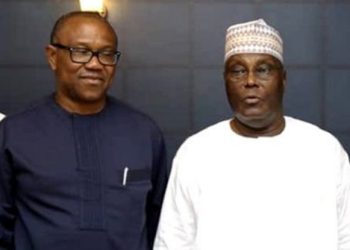



The African Democratic Congress (ADC) has responded to the recent defection of former Labour Party presidential candidate, Peter Obi, to the National Democratic Congress (NDC), with its National Publicity Secretary, Bolaji Abdullahi, shedding light on the circumstances surrounding the move.
Obi, along with former Kano State Governor Rabiu Musa Kwankwaso, officially joined the NDC on Sunday after weeks of speculation about their political future ahead of the 2027 general elections. Their decision has since sparked reactions across Nigeria’s political space, with many questioning the motivations behind the switch.
Speaking during an appearance on Arise Television’s Prime Time, Abdullahi described Obi’s departure as a calculated and strategic decision rather than a surprising development. According to him, the former Anambra State governor was in search of a political platform that could offer him a clearer and more assured path to securing a presidential ticket.
Abdullahi argued that Obi’s political ambitions required a party structure where he could have greater certainty and control over his prospects. He suggested that the NDC provided such an environment, unlike the ADC, which operates more as a coalition that demands extensive consultation, negotiation, and compromise among its members.
He explained that coalition politics often involves balancing competing interests and managing expectations among different stakeholders, making it a more complex system to navigate. In his view, Obi may have found it difficult to function effectively within such an arrangement, where no single individual can dominate the decision-making process.
Abdullahi further stated that the NDC’s structure appears to offer Obi a more straightforward route to achieving his political goals, including the possibility of securing the party’s presidential ticket without intense internal competition. He implied that this may have been a major factor influencing Obi’s decision to leave the ADC.
In addition, the ADC spokesman alleged that Obi’s expectations extended beyond just clinching the presidential ticket. He claimed that the former governor also sought to have a say in determining his running mate, a demand he suggested could complicate negotiations within a coalition framework.
Despite expressing disappointment over the exit of both Obi and Kwankwaso, Abdullahi noted that their departure has, in some ways, reduced internal tension within the party. He explained that their presence had created significant pressure as the party worked to manage varying interests and ambitions.
According to him, their exit has allowed the ADC to refocus on its internal processes and priorities without the strain of accommodating competing demands. He described the situation as both a loss and a form of relief for the party.
Abdullahi, however, downplayed the overall impact of the defections, insisting that while the departure of high-profile figures like Obi and Kwankwaso represents a setback, it does not fundamentally weaken the party’s structure or long-term prospects.
He maintained that the ADC remains committed to its goals and will continue to strengthen its position ahead of future elections, despite the recent changes in its membership.