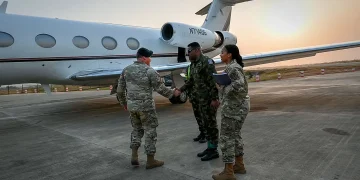


When roughly 100 American troops touched down at Bauchi Airfield in northern Nigeria on February 16, 2026, it made international headlines. News organizations from BBC, Task & Purpose to the Associated Press and Deutsche Welle scrambled to cover the story — the first large-scale deployment of U.S. military trainers to Nigeria, arriving nearly two months after American strikes on Islamic State-linked militants in Sokoto State on Christmas Day 2025. For many Nigerians — particularly Christians and peace-loving communities across the beleaguered Middle Belt region — the sight of American boots on Nigerian soil felt like the arrival of a long-awaited answer to prayer.
But even as the world focused on this new and dramatic chapter of U.S.-Nigeria security cooperation, a quieter and arguably deeper chapter was drawing to a close — and Nigerians are fighting to stop it.
Long before President Trump’s tweets about Nigerian Christians, long before the Christmas Day airstrikes in Sokoto, and long before the diplomatic spotlight swung onto Nigeria’s security crisis, a team of seasoned retired American law enforcement professionals was already on the ground doing the hard, unglamorous work of nation-building.
Under the U.S. Department of State’s International Narcotics and Law Enforcement (INL) Affairs program, American police trainers have spent the last three years working directly with the Nigeria Police Force (NPF). Over that period, they trained more than 400 Nigerian police personnel drawn from some of the force’s most critical units: the Complaint Response Unit (CRU), the Counter Terrorism Unit (CTU), the Mobile Police Unit (MOPOL), and the Special Intervention Squad (SIS).
The curriculum these American professionals delivered was comprehensive and practical. It included Public Order Management, Police Tactics, Firearms Training, Use of Force, Human Rights, Medical First Responder Training, Community Policing, Leadership Development, Train-the-Trainer modules, and Verbal De-escalation techniques — a holistic package designed not just to make Nigerian officers more lethal, but to make them more lawful, more community-conscious, and ultimately more trusted by the civilians they serve.
This is not a trivial accomplishment in a country where public trust in law enforcement has been severely strained.
Now, according to multiple sources familiar with the program, this initiative is scheduled to end on March 31, 2026.
When journalists reached out to trainers involved in the program for comment, the response was unavoidable: they are not authorized to speak on behalf of the U.S. government. The silence itself speaks volumes about the bureaucratic walls surrounding a decision that Nigerians increasingly feel must be reversed.
Across Nigeria, but especially among communities in the Middle Belt who have borne the brunt of herders-farmers conflicts, Boko Haram spillovers, and banditry, the reaction to news of the program’s impending closure has been one of alarm.
“Nigerians understand that these programs are cost-intensive,” one community advocate familiar with the trainings said, “but they are using every avenue available to reach out to the United States Government and all stakeholders to ensure that these programs are renewed until there is a lasting solution.”
The sentiment is not simply about gratitude, though there is plenty of that. It is strategic. Many Nigerians who have watched the SIS and CTU personnel evolve under the program recognize that what was built over three years cannot simply be picked up and continued by another team starting from scratch. Institutional knowledge, interpersonal trust, cultural familiarity — these are not transferable assets that survive a program termination notice.
Indeed, many Nigerians are not merely asking for an extension. They are asking for the program to be doubled in scope. With more Nigerian police units awaiting training and a security environment that has only grown more complex, the argument is not hard to make.
The deployment of approximately 100 to 200 U.S. military personnel to Bauchi is a significant escalation of American engagement. According to the U.S. Africa Command (AFRICOM), these forces are there to support Nigerian-led counter-terror operations, providing specialized technical capabilities to help Nigerian troops identify and neutralize extremist groups. Nigeria’s Defense Headquarters has been clear that the Americans are advisers, not a combat force.
This deployment follows the U.S. National Defense Authorization Act for Fiscal Year 2026, signed into law by President Trump on December 18, 2025, which allocated $413 million to AFRICOM for security operations across Nigeria and the broader African theater — a figure that underscores how seriously Washington now views the West African security landscape. AFRICOM has already delivered military equipment to Nigerian security agencies as part of this renewed commitment.
All of this is welcome. But there is a serious risk: the new arrivals and the established programs may never talk to each other.
The American trainers embedded in the INL police program have been in Nigeria for three years. Some have eaten Nigerian local food at roadside joints. Some have worshipped at local churches. They know the terrain, the culture, the sensitivities, the chain-of-command dynamics within the NPF, and — crucially — they know which officers they trained and what those officers can do. That kind of institutional and relational capital takes years to build and can be squandered in an administrative instant.
Allowing the INL police training program to expire while simultaneously deploying military trainers creates a seam between law enforcement capacity-building and military capacity-building — a seam that insurgents and criminal networks must not tear.
What Nigeria needs — and what American strategic interests should demand — is not a choice between old programs and new ones. It is synergy.
The INL police trainers bring something the newly deployed military advisers do not yet possess: deep Nigeria knowledge. Conversely, the military deployment brings scale, resources, and the weight of a renewed political commitment from Washington. These two pillars should be complementary.
Consider the specific units that the INL program has worked with. The Counter Terrorism Unit (CTU) overlaps directly with the mission of U.S. military advisers assisting in counter-insurgency. The Special Intervention Squad (SIS) deals with high-stakes law enforcement scenarios where the line between policing and military operations is often blurred in Nigeria’s conflict zones. Having American military trainers on one side and INL police trainers on another — sharing intelligence, coordinating curricula, and presenting a unified front to Nigerian security forces — would multiply the effectiveness of both programs exponentially.
There are practical mechanisms for this synergy. Joint planning sessions between INL program coordinators and AFRICOM advisers could identify gaps and overlaps. Nigerian officers who received the “Train the Trainer” modules under the INL program could serve as bridges, disseminating lessons learned to military units now working alongside American soldiers. The Human Rights and Community Policing modules, in particular, are directly relevant to military personnel operating in civilian environments — and their lessons should not be confined to the police program alone.
American strategic interests in Nigeria are not merely humanitarian, though the humanitarian case is strong. Nigeria is Africa’s most populous nation and its largest economy. Instability in Nigeria radiates across the entire West African sub-region. A collapsed or dysfunctional Nigerian security apparatus creates the same vacuum that swallowed Mali and Burkina Faso — and the same vacuum that groups like Islamic State West Africa Province and Boko Haram have repeatedly exploited.
The $413 million AFRICOM budget, the deployment of 200 troops, the Christmas Day strikes in Sokoto — all of these represent significant American investments in Nigerian stability. Allowing a three-year police training program to quietly expire in the same month that military trainers are flying in would be a strategic contradiction that undermines the coherence of the entire effort.
Beyond strategy, there is the question of credibility. Nigerian Christians, Middle Belt communities, and broader civil society have watched the United States signal renewed interest in their plight. They have taken note of every tweet, every congressional statement, every military deployment. If that rekindled interest results in a net reduction of American engagement — because one program closed while another opened — the message received on the ground will be one of confusion at best, abandonment at worst.
March 31, 2026, is a date that should be moved, extended, or eliminated from the program’s timeline. The INL police training program has produced measurable results — over 400 trained officers across critical units — and it has built something far more valuable than numbers: trust, context, and continuity. These are the foundations upon which all new programs must build, not the casualties of bureaucratic budget cycles.
Nigerian communities are not naive about Washington’s internal politics. They know that program renewals require political will, budgetary justification, and interagency coordination. They are making that case through every channel available to them, and they are right to do so.
The ask is clear: Extend the INL SIS training program. Double it if possible. Integrate it with the new military training mission where possible. Let the men and women who already know Nigeria help the new arrivals find their footing where necessary. Ordinary Nigerian who does not know much might think he/she is being made to choose between the security programs they have and the ones now arriving — give them both, working in concert.
The United States has shown it is willing to invest in Nigeria’s security at scale. The only thing left is to invest wisely — and wisdom, in this case, means not cutting the roots while you are still trying to grow the tree.
Correspondents reached out to trainers currently involved in the INL program for comment. They declined, noting they are not authorized to speak on behalf of the U.S. government.


Waooh!!!!!!!!