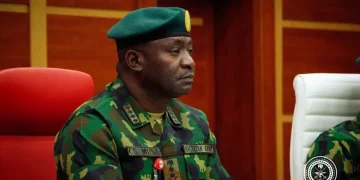


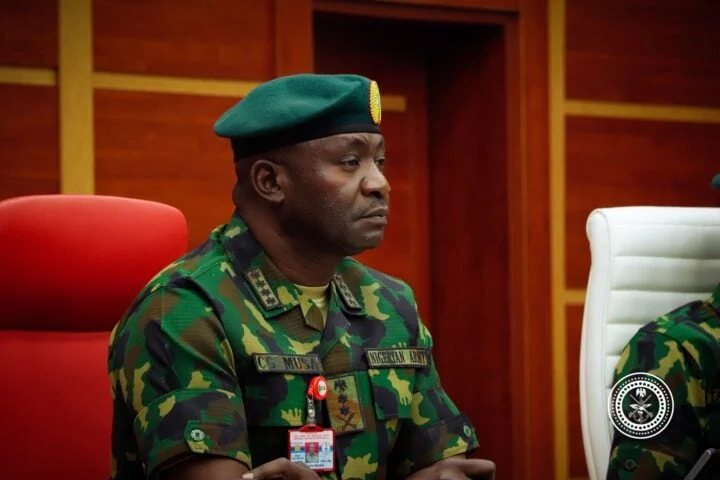
In a dramatic development on Tuesday, Bola Tinubu, President of Nigeria, nominated his immediate past Chief of Defence Staff (CDS), Christopher Musa (retired), as the new Minister of Defence. The move comes almost instantly after the resignation of Badaru Abubakar, who stepped down reportedly on health grounds only a day earlier.
The formal nomination was communicated via a letter to Senate President Godswill Akpabio, signed by the President’s Special Adviser on Information and Strategy, Bayo Onanuga. In this letter, Tinubu expressed confidence that Musa’s experience and record will fortify Nigeria’s embattled defence architecture.
Less than 24 hours after the announcement, the newly nominated Defence Minister was already meeting with Tinubu at the Presidential Villa, Abuja — his first public engagement since being relieved as CDS in October.
Why the sudden move back to the top job?
The reinstatement of Musa into a high-profile national security role comes after a sweeping shakeup in October 2025, when Tinubu dissolved the entire top brass of the Armed Forces — including Musa’s replacement — amid rumours of a foiled coup attempt.
Despite the overhaul, insecurity — including banditry, terrorism, and mass kidnappings — has surged across Nigeria, prompting increasing public anxiety and international scrutiny. Analysts believe the rapid elevation of a veteran officer like Musa is intended to restore confidence and momentum in the government’s security strategy.
Musa’s background — continuity or change?
General Musa, born in 1967 in Sokoto, had a distinguished military career long before becoming CDS in 2023. A graduate of the Nigerian Defence Academy (NDA), he was commissioned in 1991 and served in a wide range of command and operational roles — from leading infantry battalions to commanding major operations in volatile regions such as the Lake Chad Basin under the Operation Hadin Kai.
He also received the prestigious Colin Powell Award for Soldiering in 2012, recognising his professionalism and leadership.
Many observers say his appointment — coming at a time of national security emergency — represents a strategic return to experience, discipline, and institutional memory.
Mixed reactions as security expectations grow
The nomination has drawn applause from some quarters. A youth coalition and several civic organisations have thrown their weight behind Musa, urging swift Senate confirmation. They argue that with insecurity spreading across multiple states, Nigeria needs a Defence Minister who understands the military, has operational exposure, and can coordinate with other security agencies effectively.
Similarly, party insiders from the ruling All Progressives Congress (APC) — particularly from the Northwest region — have praised Tinubu’s decision, calling it “a perfect choice” given Musa’s pedigree.
Nevertheless, the speed of the transition — from the resignation of Badaru Abubakar to Musa’s nomination — has raised concerns among some analysts about transparency, the propriety of reappointing a recently retired top military officer, and whether such upheavals may affect morale within the armed forces.
Critics warn that re-instating a former power fulcrum may not guarantee rapid turnaround, given systematic challenges: resource constraints, coordination bottlenecks among security agencies, and the deeply embedded socioeconomic roots of insecurity.
What’s next: Senate confirmation & security roadmap
For now, Musa remains a “nominee” — his appointment requires the approval of the Senate of the Federal Republic of Nigeria. In a statement following the submission, the Senate Leader, Opeyemi Bamidele, said the chamber will treat the screening as a matter of urgent national importance.
A successful confirmation would place Musa at the helm of the Defence Ministry just as the government intensifies efforts against terrorism, banditry, and kidnappings ahead of the festive season and a critical election cycle.
In the coming days, the new Defence Minister — functioning under the President’s renewed commitment to security reforms — will be under pressure to produce quick, tangible results: from improving inter-agency cooperation to stabilising volatile regions.
Only time will tell if this is a turning point for Nigeria’s security architecture — or another reshuffling amid persistent uncertainty.

Tinubu says opposition without clear vision won’t be allowed to take Nigeria backward in 2027
President Bola Tinubu, speaking on Sunday, urged Nigerians to act carefully in choosing their leaders, cautioning against handing power to...