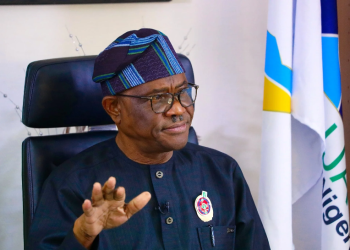
Allegations of large-scale irregularities in land allocation under the Minister of the Federal Capital Territory (FCT), Nyesom Wike, have sparked widespread calls for investigation, with civil society organisations urging President Bola Ahmed Tinubu, the Economic and Financial Crimes Commission (EFCC), and the Independent Corrupt Practices Commission (ICPC) to intervene.
The Minister is accused of allocating over 2,000 hectares of prime Abuja land to his son, Joaquin Wike, through a company named Joaq Farms and Estates Ltd, according to reports from multiple credible sources and advocacy groups. The parcels are allegedly located in high-value districts including Maitama, Asokoro, Guzape, Bwari, Gaduwa, and Kwaita, with an estimated collective worth running into billions of naira.
Civil society group National Citizens Action Network Against Trafficking (NACAT) and other watchdogs allege that Wike used his position to reallocate plots to friends, political associates, and family members, sidelining legitimate investors and ordinary citizens.
According to documents obtained by activists and shared with journalists, several of the contested plots were initially owned by individuals or organisations who had met all regulatory requirements, including payment of ground rent and development of the land. These plots were reportedly revoked and reassigned under questionable circumstances.
One case that has attracted particular attention involves Plot 584, Cad Zone E08, a four-hectare property in the Karu area of Abuja. The estate, said to have obtained full government approval and fulfilled all statutory obligations, was demolished without formal notice, prompting allegations of abuse of power.
Pressure Mounts for Official Response
The allegations have triggered public outcry and growing demands for transparency from the federal government. Activists and legal analysts have called on the EFCC and ICPC to immediately open independent investigations into the land deals, review allocation records, and trace the ownership of implicated entities.
NACAT and other civil society groups have stated that the alleged land reallocation patterns suggest misuse of office and a breach of due process. The organisations argue that these developments could undermine Nigeria’s efforts to promote transparent governance and erode public confidence in the Tinubu administration’s anti-corruption posture.
Calls for Presidential Oversight
As Wike serves directly under President Tinubu, critics and opposition figures have urged the Presidency to demonstrate leadership by ordering a full-scale audit of all FCT land allocations since Wike took office in August 2023.
Some commentators and rights groups have also suggested that the Minister be suspended pending the outcome of an investigation, noting that failure to act could fuel perceptions of selective justice and weaken the credibility of anti-corruption efforts.
When contacted, officials from the EFCC and ICPC did not immediately comment on whether any formal investigation into the allegations has been launched.
Background
Wike, the former Governor of Rivers State, was appointed Minister of the FCT by President Tinubu in August 2023. Since assuming office, he has carried out several high-profile demolitions and policy reforms in Abuja, many of which have attracted both praise and criticism.
The latest developments, however, mark one of the most serious allegations yet during his tenure, with potential legal and political implications for the administration.
What’s Next?
Civil society groups are planning to submit formal petitions to anti-graft agencies and the National Assembly in the coming weeks. There are also calls for the media and public to demand the publication of land allocation records and transparency in the FCT’s land administration process.
As the situation unfolds, stakeholders across the political and civic landscape are watching closely to see whether Nigeria’s institutions will respond with what many have described as a test case for accountability in public office.