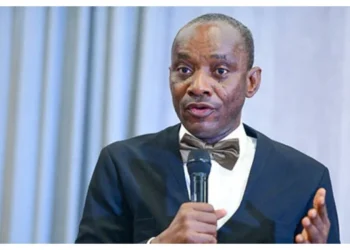
President Bola Ahmed Tinubu has explained the rationale behind his decision to appoint Professor Joash Ojo Amupitan (SAN) as the new Chairman of the Independent National Electoral Commission (INEC).
Speaking during Thursday’s virtual meeting of the National Council of State, attended by former Heads of State Ibrahim Babangida and Abdulsalami Abubakar, President Tinubu noted that Amupitan’s nomination represents both merit and inclusion. He described him as “the first person from Kogi State in the North-Central region to be nominated for the top electoral position.”
According to a statement issued by the President’s Special Adviser on Information and Strategy, Bayo Onanuga, Tinubu emphasized that the appointment reflects his administration’s commitment to equity and competence.
“Professor Amupitan is the first person from Kogi State to be nominated as INEC Chairman, and he is completely apolitical,” Onanuga quoted the President as saying.
The Council of State unanimously endorsed Amupitan’s nomination following deliberations. Governor Ahmed Usman Ododo of Kogi State, who attended the meeting, reportedly praised the nominee as “a man of integrity and high professional standards.”
Tinubu presented Amupitan’s nomination to fill the vacancy created by the exit of Professor Mahmood Yakubu, who has served as INEC Chairman since 2015. The President is expected to forward Amupitan’s name to the Senate for screening and confirmation in accordance with constitutional provisions.
Profile of the New INEC Chairman
Professor Joash Ojo Amupitan, aged 58, hails from Ayetoro Gbede in Ijumu Local Government Area of Kogi State. He is a Professor of Law at the University of Jos, where he also earned his academic degrees.
A distinguished scholar, Amupitan specializes in Company Law, Law of Evidence, Corporate Governance, and Privatisation Law. He was elevated to the rank of Senior Advocate of Nigeria (SAN) in 2014, a recognition of his contribution to legal scholarship and practice.
Among his notable publications are Corporate Governance: Models and Principles (2008), Documentary Evidence in Nigeria (2008), Evidence Law: Theory and Practice in Nigeria (2013), and Principles of Company Law (2013).
Beyond academia, Amupitan has served on several corporate and educational boards, including Integrated Dairies Limited in Vom, the Nigerian Institute of Advanced Legal Studies, and the Council of Legal Education.
Born on April 25, 1967, Amupitan is widely respected for his legal expertise, administrative discipline, and balanced approach to institutional reform.
As the new head of Nigeria’s electoral body, many analysts are keenly observing how he will build on or differ from the legacy of his predecessor, Mahmood Yakubu, whose tenure saw major electoral reforms and technological innovations but also drew criticism over election logistics and transparency.
Public discussions have already begun on how Professor Amupitan’s tenure might reshape the future of Nigeria’s electoral management system, with expectations high for neutrality, credibility, and innovation in subsequent elections