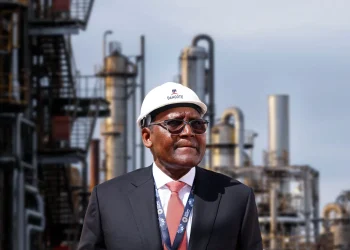
Abdul Samad Rabiu, Chairman of BUA Group, has expressed optimism that the naira will appreciate significantly, projecting an exchange rate of between ₦1,300 and ₦1,400 to the dollar by the close of 2025. Rabiu made this forecast on Wednesday while addressing journalists shortly after meeting with President Bola Ahmed Tinubu at the Presidential Villa in Abuja.
The industrialist commended President Tinubu’s “bold and decisive” economic reforms, describing them as critical steps already yielding visible benefits for both the economy and the business community. According to him, the reforms are setting the stage for a stronger currency and a more stable operating environment for enterprises.
“I expect that the exchange rate will strengthen further,” Rabiu said. “By the end of the year, we should be looking at around ₦1,300 or ₦1,400 to the dollar, and this is a development worth celebrating.”
Highlighting the reforms’ impact on the foreign exchange market, Rabiu explained that companies are no longer entirely dependent on the Central Bank of Nigeria (CBN) for access to dollars. He noted that many businesses now have the ability to source foreign exchange independently, using international banking platforms and credit card systems. This, he stressed, marks a significant departure from the past.
“For this progress, we must give full credit to the President and his administration. Their policies are laying a solid foundation for a stronger economy, a more resilient naira, and a brighter outlook for businesses and Nigerians,” Rabiu added.
The BUA boss also urged Nigerians to exercise patience, stressing that the positive effects of reforms take time to fully materialise. He pointed to recent improvements in commodity prices as an early sign of progress. “If you compare the cost of food items this year to what we had last year, you’ll notice a considerable drop in prices across several commodities. Clearly, things are improving, and we must continue to support the government as these reforms deepen,” he said.
President Tinubu, shortly after assuming office in 2023, introduced sweeping reforms in the foreign exchange system, including the unification of multiple official FX windows into a single market-driven rate. The move effectively allowed the naira to float, eliminating distortions created by parallel market disparities.
Rabiu has consistently endorsed these policy shifts. In July, he noted that the reforms had dismantled the old system, where businesses had to lobby the CBN for foreign exchange allocations. The former dual-rate structure, he argued, artificially suppressed the official rate while pushing businesses to the parallel market, thereby restricting access to vital foreign currency.
He contrasted the present regime, which he described as transparent and efficient, with the previous one that, in his words, “created artificial scarcity and forced companies to seek favours for dollar access.” Rabiu even joked about how little he now interacts with the apex bank. “Since the current CBN Governor assumed office, I’ve only seen him twice. Before, I had to visit the CBN every two weeks just to lobby for FX. That was the only way to survive,” he recalled.
With the reforms now reshaping Nigeria’s monetary landscape, Rabiu maintains that the outlook for the naira is bright, provided the government sustains its current momentum.