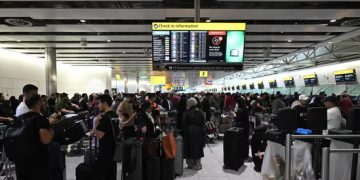


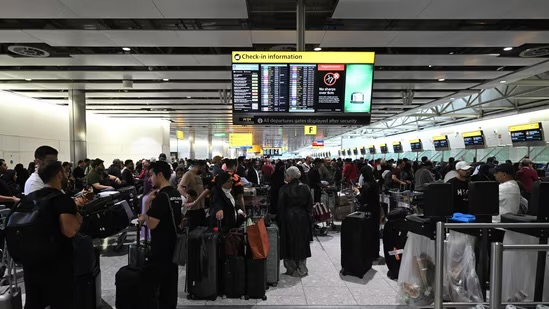
A cyberattack on Saturday targeting a provider of airline check-in and boarding systems triggered major disruptions across several European airports, including London Heathrow, the continent’s busiest hub. The incident caused widespread flight delays and cancellations and is expected to spill over into Sunday operations.
The disruption is linked to MUSE, a passenger processing software developed by Collins Aerospace, which supplies critical systems for airlines globally. Collins Aerospace’s parent company, RTX, confirmed a “cyber-related disruption” but did not specify the airports affected or the source of the attack. It added that the issue was limited to check-in and baggage drop systems and could be partly managed with manual processes while engineers worked on a fix.
Airports in London, Brussels, Berlin, Dublin, and Cork confirmed impacts of varying severity. At Heathrow, Brussels, and Berlin alone, 29 flights had been canceled by midday Saturday, according to aviation data provider Cirium, out of hundreds scheduled departures. Brussels Airport reported four flight diversions, significant delays, and later instructed airlines to cancel half of Sunday’s departing flights to reduce congestion and passenger frustration.
Berlin Airport advised travelers of extended waiting times, while Dublin and Cork reported only minor impacts. Frankfurt Airport, Germany’s busiest, said it had not been affected.
Passengers faced long queues and uncertainty. Some travelers expressed frustration over the lack of timely communication. “We haven’t been told anything except that there was a technical fault,” said one passenger at Berlin Airport, noting that reports online pointed to a cyberattack. Others called the disruption “incomprehensible,” questioning why defenses against such attacks remain inadequate.
Authorities and cybersecurity experts are investigating the source of the attack. The European Commission said there was currently no evidence of a “widespread or severe” assault. Analysts suggest the incident may have been caused by ransomware or targeted digital sabotage. Rafe Pilling, director of threat intelligence at Sophos, highlighted that the attack demonstrated “the fragile and interdependent nature of the digital ecosystem underpinning air travel.”
This disruption follows a series of high-profile cyber incidents globally, with recent breaches affecting industries from healthcare and defense to retail and automotive. In the UK, a cyberattack on Jaguar Land Rover earlier this year halted vehicle production. Collins Aerospace itself was reportedly targeted by ransomware in 2023, though the company did not comment on whether there was any link to Saturday’s attack.
Despite the disruption, some airlines managed to minimize the fallout. EasyJet reported normal operations, while Delta Air Lines said it had implemented a workaround that limited delays. United Airlines acknowledged “minor departure delays” but no cancellations. Ryanair and British Airways’ parent company IAG did not immediately respond to requests for comment.
Governments are closely monitoring the situation. Britain’s transport minister, Heidi Alexander, said she was receiving regular updates, while cyber-defense authorities in the UK and Germany confirmed they were in contact with affected airports.
For now, passengers are being urged to check with their airlines before heading to airports. With Brussels Airport already bracing for reduced flight schedules on Sunday, the cyberattack’s impact is set to ripple across European air travel through the weekend.




Получить диплом любого университета мы поможем. Купить диплом о высшем образовании в Сочи – [url=http://diplomybox.com/kupit-diplom-o-vysshem-obrazovanii-v-sochi/]diplomybox.com/kupit-diplom-o-vysshem-obrazovanii-v-sochi[/url]