

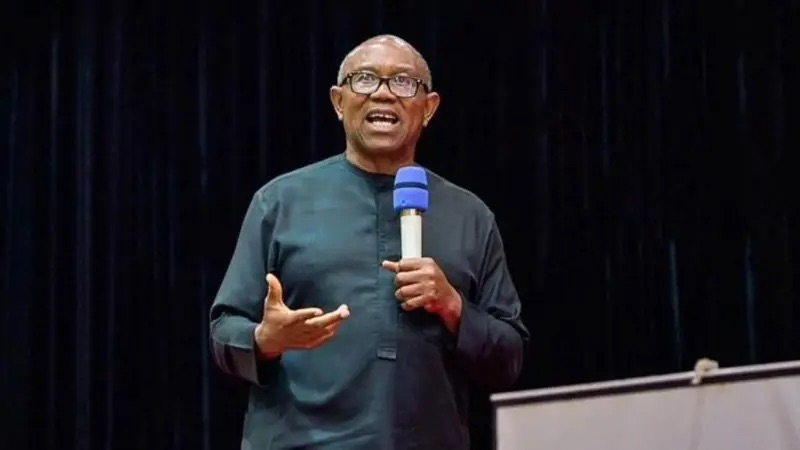
The presidential flag bearer of the (NDC) Nigeria Democratic Congress , Peter Obi, has strongly criticised the administration of President Bola Tinubu, accusing it of excessive borrowing, weak financial control, and poor transparency in the management of public resources.
In a statement shared via his official X account on Tuesday, Obi alleged that Nigeria’s total public debt had surged to around N200 trillion under the current government, describing the trend as dangerously unsustainable and harmful to the country’s long-term economic stability.
He referenced figures attributed to the Federation’s Budget Office, claiming that between January and September 2025, the federal government obtained loans totaling about N11.89 trillion. This, he noted, went beyond the approved borrowing projection of N10.34 trillion, exceeding the target by roughly N1.54 trillion.
According to him, such a deviation from fiscal plans would normally require detailed justification and oversight in a well-governed system, but he argued that adequate accountability has been lacking.
Obi also drew attention to what he described as a worrying imbalance in government spending priorities. He stated that out of N17.58 trillion allocated for capital development projects within the same period, only N3.10 trillion—about 17.66 percent—was actually utilized. This, he said, left more than N14 trillion unaccounted for in terms of capital deployment.
He questioned the destination of the remaining borrowed funds, suggesting that the limited spending on infrastructure projects raised concerns about possible misallocation. Obi further lamented what he called the absence of clear explanations from authorities regarding the gap between funds borrowed and their visible application.
He argued that Nigerians deserve full disclosure on whether the unutilised resources were redirected toward recurrent expenses, administrative luxuries, or political activities, insisting that public funds must be properly accounted for at all times.
The former governor of Anambra State maintained that the situation reflected a broader failure in fiscal discipline and governance transparency, stressing that national resources should be managed with responsibility and openness.
Meanwhile, economic commentator Dele Oye, Chairman of the Alliance for Economic Research and Ethics LTD/GTE, also expressed concern over Nigeria’s growing debt profile. He noted that the current administration has accumulated significant borrowing within a short period, far exceeding historical levels recorded over several decades.
Oye explained that while Nigeria’s total debt stood at N159.28 trillion as of April 2026, the pace of accumulation in recent years has been unusually rapid. He compared current figures with earlier periods, pointing out that debt levels rose gradually from independence until the mid-2000s, but have expanded sharply in the last decade.
He also highlighted concerns about the country’s ability to generate sufficient revenue, noting that Nigeria’s tax collection rate remains very low compared to other African economies. This weak revenue base, he said, forces the government to rely heavily on borrowing to finance budgets.
According to him, although Nigeria’s debt-to-GDP ratio may appear moderate on paper, the more troubling indicator is the proportion of revenue spent on debt servicing, which continues to rise beyond sustainable levels.
Oye further warned that a large portion of the national budget is now consumed by debt repayment, leaving limited resources for critical sectors such as education, healthcare, and infrastructure development.
He concluded that Nigeria possesses the human and economic capacity to improve its financial situation, but emphasized that meaningful progress will depend on stronger discipline, improved revenue generation, and firm political commitment to reform.