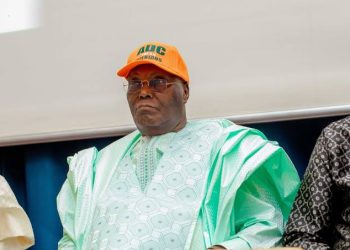


Former Vice President and African Democratic Congress (ADC) presidential candidate, Atiku Abubakar, has recounted the steps he and former President Olusegun Obasanjo took to retrieve public funds allegedly misappropriated before they assumed power in 1999.
Atiku made the disclosure while speaking with journalists on Wednesday, explaining how the administration approached individuals suspected of taking government resources and negotiated the return of the funds.
According to the former vice president, the administration inherited the country’s affairs from the government of former military Head of State, General Sani Abacha, when the civilian administration came into office in 1999.
He explained that the new government was confronted with information concerning individuals who were believed to have diverted public resources during previous administrations. Rather than immediately resorting to confrontation, he said, the government adopted a strategy aimed at recovering as much of the money as possible.
Atiku recalled that Obasanjo initially approached the issue with anger because of the extent of the alleged financial wrongdoing. He said he had to calm the former president and persuade him that a different approach would be more effective in recovering the funds.
He explained that records containing details of the amounts allegedly taken by various individuals were available to the administration. Based on those records, the government invited the affected persons and engaged them in discussions over the repayment of the funds.
According to Atiku, the individuals were asked to return the money they had taken from the government while being permitted to retain a small portion as an incentive to encourage repayment.
He said the arrangement involved allowing those involved to keep five per cent of the funds while returning the remaining 95 per cent to the government.
Atiku revealed that he headed the committee responsible for overseeing the recovery process, with Aliyu Gusau serving as one of its members.
He maintained that the initiative produced results and enabled the government to retrieve significant amounts of money for the country.
Reflecting on the process, the ADC candidate said the approach demonstrated that recovering stolen public resources required practical measures rather than relying solely on confrontation and lengthy legal proceedings.
He further explained that the experience eventually contributed to the establishment of the Economic and Financial Crimes Commission (EFCC), an institution created to tackle financial crimes and corruption in the country.
Atiku said the creation of the anti-graft agency was part of broader efforts by the Obasanjo administration to strengthen Nigeria’s fight against corruption and improve accountability in public service.
He stressed that the recovery initiative was aimed at ensuring that resources belonging to the Nigerian people were returned to government coffers.
The former vice president’s account provides insight into the methods adopted by the administration during the early years of Nigeria’s return to democratic rule.
Atiku also used the opportunity to highlight his role in the process, noting that he personally chaired the committee responsible for negotiating the recovery of the funds.
He maintained that the exercise was undertaken in the interest of the country and was intended to restore resources that had allegedly been taken from the Nigerian state.
His comments come amid renewed political discussions over corruption, public accountability and the recovery of stolen assets as political parties and presidential contenders position themselves ahead of the 2027 general elections.