

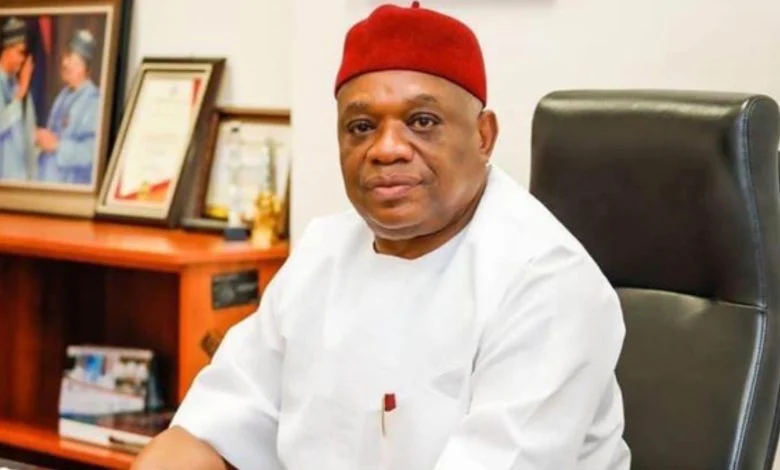
Senator Orji Uzor Kalu has warned that he could leave the All Progressives Congress (APC) if President Bola Tinubu is found to have disrespected the Catholic Church or its bishops, stressing that his loyalty to the church remains unwavering. The former Abia State governor made the remarks while reacting to the ongoing public debate surrounding recent exchanges between the Presidency and leaders of the Catholic Church.
Kalu, a practicing Catholic, said he has no reason to remain in a political party that undermines his faith or disrespects the country’s Catholic leadership. He, however, noted that he does not believe President Tinubu has personally insulted the church and urged Nigerians to avoid spreading misinformation capable of creating religious tension.
According to the senator, the Catholic Church has played a vital role in promoting education, peace, social justice and national development over the years. He maintained that religious institutions deserve respect and should be free to express views on issues affecting the country without fear of intimidation.
The lawmaker also appealed to political office holders and public commentators to exercise restraint when responding to statements made by religious leaders. He stressed that disagreements should be handled with mutual respect in order to preserve national unity and religious harmony.
Kalu’s comments come amid heightened public discussions following recent interactions between the Presidency and leaders of the Catholic Bishops’ Conference of Nigeria (CBCN). The exchanges have generated mixed reactions from political figures, religious groups and civil society organisations, with some calling for more constructive engagement between government and faith-based institutions.
While reaffirming his support for the Tinubu administration, Kalu said his position on the matter should not be interpreted as opposition to the government. Instead, he described his remarks as a principled stand in defence of the Catholic faith, adding that respect for religious institutions is essential in a diverse society like Nigeria.
Political analysts say the development reflects the increasing intersection of religion and politics as preparations for the 2027 general elections gather momentum. They noted that statements by influential political leaders on sensitive national issues often attract significant public attention and debate.
Observers have also urged political leaders, religious organisations and government officials to maintain dialogue based on respect, tolerance and constitutional rights. They argue that constructive engagement between public institutions and faith communities remains important for national cohesion and democratic stability.
As political activities continue ahead of the next general elections, stakeholders have called on all parties to focus on issues of governance, security and economic development while avoiding rhetoric capable of deepening religious or political divisions.