

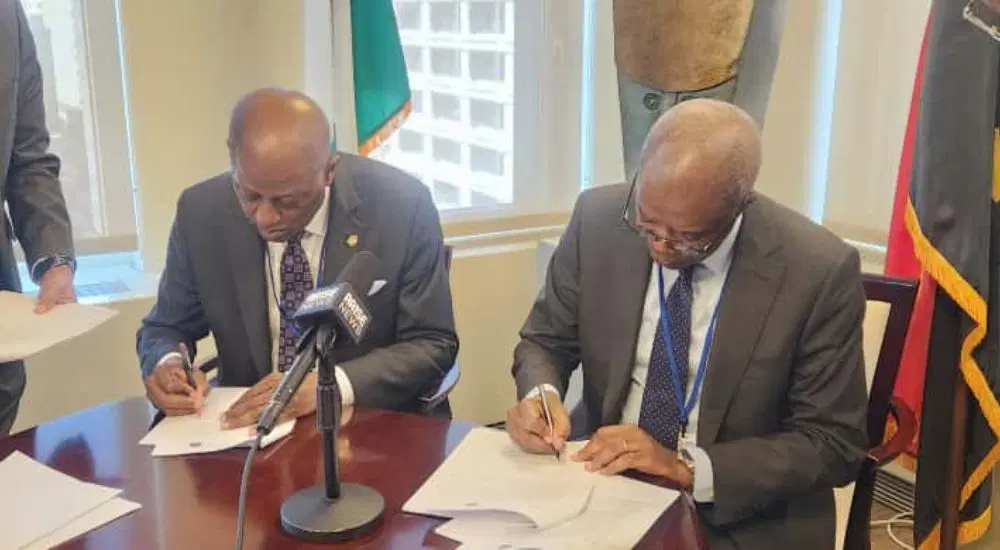
Nigeria and Angola have taken a major step toward deepening regional economic cooperation as the Central Banks of both nations signed a Memorandum of Understanding (MoU) on bilateral technical collaboration in Washington, D.C.
The agreement, endorsed on Thursday, aims to enhance cooperation between the two financial institutions through shared expertise, joint capacity-building efforts, and coordinated regulatory supervision. It marks a new era of partnership between two of Africa’s biggest oil-producing economies, with the potential to strengthen financial stability and promote sustainable growth across the continent.
According to details from the signing ceremony, the MoU provides a framework for mutual technical assistance in key areas such as financial market operations, foreign reserves management, payment systems, banking supervision, and anti-money laundering initiatives. It also covers cross-border supervision of financial institutions, cybersecurity information sharing, and coordinated measures to address financial risks.
The agreement further seeks to ensure transparent information exchange between both central banks while developing practical cooperation in monetary policy research, economic statistics, and the management of clearing and settlement systems.
Speaking during the event, the Governor of the Central Bank of Nigeria (CBN), Olayemi Cardoso, described the partnership as “a timely and strategic initiative that reflects Africa’s growing commitment to regional integration.”
“This collaboration between Nigeria and Angola comes at a crucial time when African nations must work together to strengthen their institutions, promote economic resilience, and improve financial governance,” Cardoso said.
He explained that the signing at a global policy forum underscored both nations’ commitment to building bridges and promoting stronger African representation in global finance. “We face common challenges across the continent, and partnerships like this allow us to share solutions, deepen trust, and build a more united Africa,” he added.
The CBN governor expressed confidence that the MoU would lead to long-term benefits, including improved monetary stability, enhanced institutional capacity, and expanded investment opportunities in both countries.
In his remarks, the Governor of the Central Bank of Angola, Manuel António Tiago Dias, commended Nigeria for its leadership role in promoting financial collaboration within Africa. He reaffirmed Angola’s readiness to work closely with the CBN to achieve the objectives outlined in the agreement.
“We are pleased to sign this cooperation protocol with Nigeria, a country that shares our vision for stronger African financial systems and economic independence,” Dias said.
Observers say the agreement could become a model for future cooperation among African central banks, especially as countries seek to implement the goals of the African Continental Free Trade Area (AfCFTA) and promote greater financial inclusion.
By fostering joint training, knowledge exchange, and shared regulation, the Nigeria–Angola MoU is expected to contribute to a more robust and integrated African financial system capable of supporting sustainable economic development across the continent.