

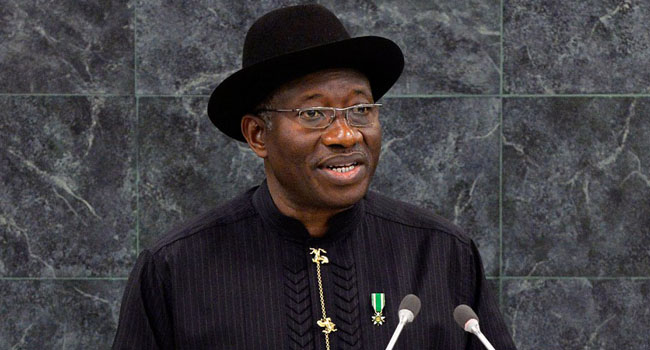
Former President Goodluck Jonathan has stirred a fresh debate over Nigeria’s prolonged battle with Boko Haram, questioning why his successor, the late President Muhammadu Buhari, was unable to swiftly end the insurgency despite once being mentioned by the group as a potential mediator.
Speaking at a book launch in Abuja, Jonathan reflected on how, during his administration, a faction of Boko Haram nominated Buhari to lead peace negotiations with the federal government. According to him, that development led many Nigerians to believe Buhari would find an easier path to resolving the conflict once he assumed power in 2015.
“One of the committees we set up then, Boko Haram nominated Buhari to represent them in talks with the government,” Jonathan recalled. “So, I thought that when Buhari became president, it would be easier for him to negotiate peace with them and end the conflict. But the insurgency is still with us today.”
Jonathan’s remarks quickly drew a sharp rebuttal from Garba Shehu, a former presidential spokesperson under Buhari. Shehu described the claim as “misleading”, arguing that neither Boko Haram’s founder, Mohammed Yusuf, nor his successor, Abubakar Shekau, ever nominated Buhari for any negotiation.
He explained that the supposed nomination originated from a faction led by Abu Mohammed Ibn Abdulaziz, whom he alleged was politically motivated and had no genuine connection to Boko Haram’s core leadership. Shehu maintained that Buhari was a frequent target of the sect and even survived a bomb attack in Kaduna in 2014.
However, political observers note that Jonathan’s comments go beyond the issue of nomination. They reflect a broader national frustration that despite Buhari’s campaign promises and military background, his administration failed to eliminate the insurgency, which continues to claim lives and displace communities in the North-East.
During his campaign, Buhari repeatedly criticised Jonathan’s handling of Boko Haram and promised to end the insurgency within six months of assuming office. He famously told an audience at Chatham House, London, that he would “lead from the front” in restoring peace and stability to Nigeria.
Buhari also vowed to prioritise the welfare of soldiers, provide modern weapons, and “choke Boko Haram’s financial channels.” His early rhetoric earned him applause both at home and abroad. Yet, by December 2015 barely six months into his tenure Buhari declared that Nigeria had “technically defeated Boko Haram.”
That claim, however, was short-lived. In the years that followed, Boko Haram and its offshoots, particularly ISWAP (Islamic State West Africa Province), continued to launch devastating attacks on military bases and civilian settlements. The insurgency also spread beyond its original stronghold in Borno State, affecting parts of Niger, Chad, and Cameroon.
Security analysts argue that Buhari’s “technical victory” remark was premature and reflective of a misunderstanding of asymmetric warfare. While government forces reclaimed territories once controlled by the militants, suicide bombings, ambushes, and kidnappings persisted, showing that the group remained capable of terrorising soft targets.
Jonathan’s renewed comments have reignited debate on the root causes of insecurity and the lack of a unified national strategy to end insurgency. He insists that Boko Haram’s resilience cannot be explained merely by poverty or hunger but must include recognition of external sponsorship and the complex political dynamics that sustain conflict.
Similarly, Chief of Defence Staff, General Christopher Musa, recently emphasised the need to tackle the underlying socio-economic issues poverty, unemployment, and poor education that breed extremism. Former President Olusegun Obasanjo also urged the nation to confront the failures of the past 15 years with honesty and resolve.
More than a decade after Jonathan left office, Boko Haram remains a persistent threat, with reports of renewed militant activity around Lake Chad and Sambisa Forest. Despite repeated government assurances, Nigerians continue to question whether the country’s leaders truly grasp the depth and complexity of the crisis.
Jonathan’s reflections, while controversial, have reopened a critical conversation about accountability, leadership promises, and the realities of counter-terrorism in Nigeria a conversation the nation can no longer afford to ignore.

**back biome official**
Mitolyn is a carefully developed, plant-based formula created to help support metabolic efficiency and encourage healthy, lasting weight management.