

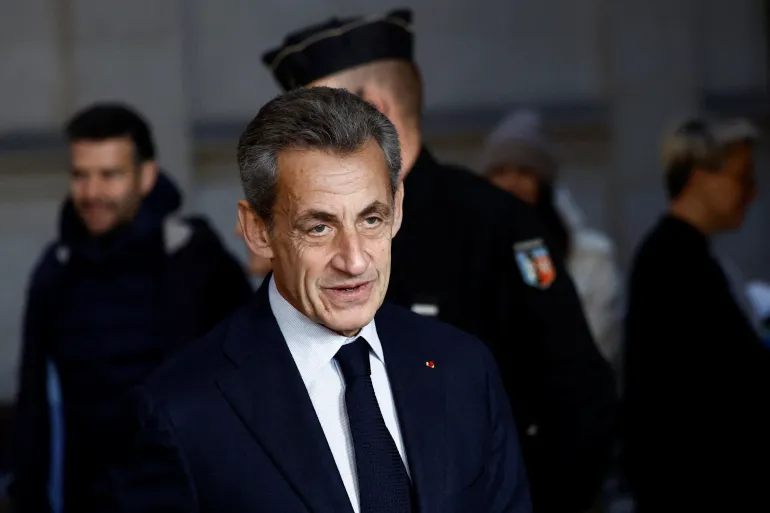
A Paris court has sentenced former French President Nicolas Sarkozy to five years in prison and delivered an unexpected twist: he must serve time even while appealing the conviction. The ruling, announced Thursday, stems from his trial over allegations that his 2007 presidential campaign was secretly bankrolled with funds from Libya.
The decision marks the first time a French head of state has been ordered to prison under such terms. However, the 70-year-old will not immediately be taken into custody. Judges said the exact date of his incarceration will be set later, sparing Sarkozy the spectacle of being escorted from the courtroom in handcuffs.
The court found Sarkozy guilty of criminal association between 2005 and 2007, ruling that he permitted close allies to pursue Libyan financing for his successful 2007 campaign in exchange for diplomatic favors. He was acquitted on three other counts, including passive corruption, illegal campaign financing, and concealment of embezzled public funds.
Two former ministers and close associates—Claude Guéant and Brice Hortefeux—were also convicted of criminal association but cleared of other charges. The verdict suggests judges believed a conspiracy existed to solicit Libyan money, though they were not persuaded that Sarkozy personally handled funds or that Libyan money definitively entered his campaign.
Still, under French law, such a scheme constitutes a crime even if payments cannot be conclusively traced. “He allowed his close associates to obtain or attempt to obtain financial support in Libya,” the presiding judge said in her hours-long reading of the verdict.
Sarkozy, accompanied by his wife, singer Carla Bruni-Sarkozy, listened from the front row of the defendant’s seats, while reporters, spectators, and his three adult sons filled the courtroom. The former president, who governed from 2007 to 2012, has consistently denied wrongdoing, describing the accusations as politically motivated.
The case involved 11 co-defendants, including three ex-ministers. It drew renewed attention to France’s shadowy diplomatic dealings with Libya in the early 2000s, as Colonel Muammar Gadhafi sought to reestablish ties with Western governments.
The claims first emerged in 2011 when Libyan officials, including Gadhafi, alleged they had funneled millions of euros into Sarkozy’s 2007 campaign. In 2012, French investigative outlet Mediapart published a purported Libyan memo referring to a €50 million agreement. Sarkozy dismissed it as a forgery and successfully sued for defamation. On Thursday, the court agreed the document was likely fake, but prosecutors relied on testimony and travel records showing Sarkozy’s associates made frequent trips to Tripoli at the time.
One key witness, Franco-Lebanese businessman Ziad Takieddine, initially claimed he delivered cash-filled suitcases to Sarkozy’s ministry but later retracted the story. He died in Beirut earlier this week at age 75, before the trial concluded. His reversal is itself the subject of a separate probe into possible witness tampering, in which Sarkozy and his wife face preliminary charges.
Throughout proceedings, Sarkozy denounced the allegations as a “plot” hatched by “liars and crooks” aligned with the Gadhafi clan. He argued the case was revenge for his pivotal role in 2011 NATO-backed airstrikes that toppled Gadhafi.
“What credibility can be given to such statements marked by vengeance?” Sarkozy asked during the trial.The ruling adds to Sarkozy’s growing list of convictions. Last year, he was found guilty of overspending in his failed 2012 re-election bid and sentenced to a year in prison. He is still appealing that case. He has also been convicted of attempting to bribe a magistrate in 2014, for which he briefly wore an electronic monitoring bracelet before receiving conditional release.
Once awarded France’s highest honor, Sarkozy was stripped of the Legion of Honor medal in June following those convictions. Despite his legal woes, he continues to wield influence in French conservative politics and enjoys visibility through his high-profile marriage.