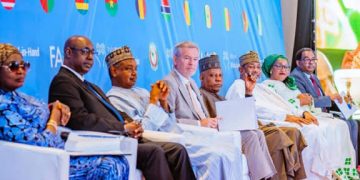


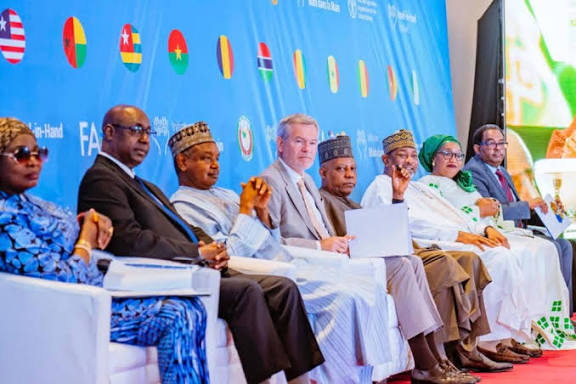
The government on Tuesday unveiled new agricultural reforms and investment incentives designed to create over 21 million jobs and reposition the sector as a driver of food security and economic growth. Vice President Kashim Shettima announced the initiatives at the Food and Agriculture Organisation’s National and Subregional Hand-in-Hand Investment Forum in Abuja, describing hunger as a unifying challenge that exposes global vulnerability.
The new measures are part of President Bola Tinubu’s economic agenda and Nigeria’s 2021–2025 National Development Plan, which seeks to lift 35 million people out of poverty while strengthening rural economies. According to Shettima, Nigeria’s underutilised irrigation potential remains a key obstacle. Although the country can irrigate more than three million hectares of farmland, less than 10 percent is currently being tapped. He argued that strategic investments in irrigation could triple yields, reduce dependence on seasonal farming, and shield farmers from climate shocks.
Outlined reforms include a single-window platform for land registration, stronger access to agricultural credit, large-scale mechanisation projects, and investment in irrigation infrastructure. Shettima emphasised that Nigeria is open for business and urged both local and foreign investors to seize opportunities in agribusiness. “Let us work hand-in-hand to build a nation where no one goes to bed hungry, where rural communities are hubs of wealth creation, and where agriculture becomes the bedrock of our prosperity,” he said.
The Minister of Agriculture and Food Security, Abubakar Kyari, highlighted Nigeria’s large arable land, clement weather, and expanding digital economy as strong incentives for investors. Minister of Budget and Economic Planning, Senator Atiku Bagudu, added that agriculture remains central to diversifying the economy and realising the government’s Renewed Hope Agenda.
Regional and international partners also weighed in. The Gambia’s Agriculture Minister, Dr. Demba Sabally, praised Nigeria’s leadership in rice and cassava production, calling for peer review among West African countries to share lessons. FAO’s representative in Nigeria and ECOWAS, Dr. Hussein Gadain, described the Hand-in-Hand Initiative as an evidence-based, country-led programme to accelerate agricultural transformation, tackle malnutrition, and reduce inequality. He commended Shettima’s passion for food security and his drive to attract crucial investments.
Similarly, the European Union Delegation Head in Nigeria, Gautier Mignot, reaffirmed the EU’s role as a long-term partner, pointing to an €80 million investment across key value chains in seven states.
Despite optimism, farmers expressed caution. The National President of the All Farmers Association of Nigeria, Kabir Kebram, warned that without concrete implementation, the policies would remain ineffective. Chairman of the Competitive African Rice Forum, Peter Dama, echoed this, noting that many government promises in the past had not been matched with delivery.
Women farmers also voiced concerns. The Small-Scale Women Farmers Organisation in Nigeria (SWOFON) said interventions have failed to address key challenges, including access to land, affordable loans, and inclusion in policy decisions. National Secretary Chinasa Asonye criticised Nigeria’s inability to meet the 10 percent budgetary allocation to agriculture under the Malabo Declaration, pointing out that current spending stands at less than 1.9 percent.
Asonye added that smallholder farmers, who form the backbone of Nigeria’s food supply, have not benefitted significantly from government interventions. She noted that while some northern states provide support, southern states lag behind. She also lamented the loss of initiatives like the school feeding programme, which previously boosted demand for farm produce.
Although the Federal Government’s reforms have been welcomed as ambitious and necessary, farmers stress that only effective implementation will determine whether the promises translate into real gains for Nigeria’s agriculture and food security.