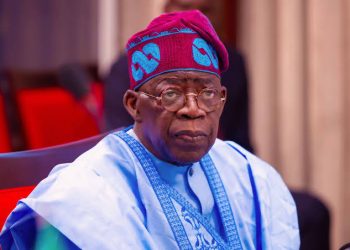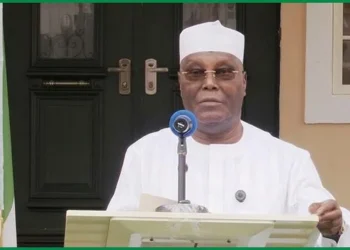


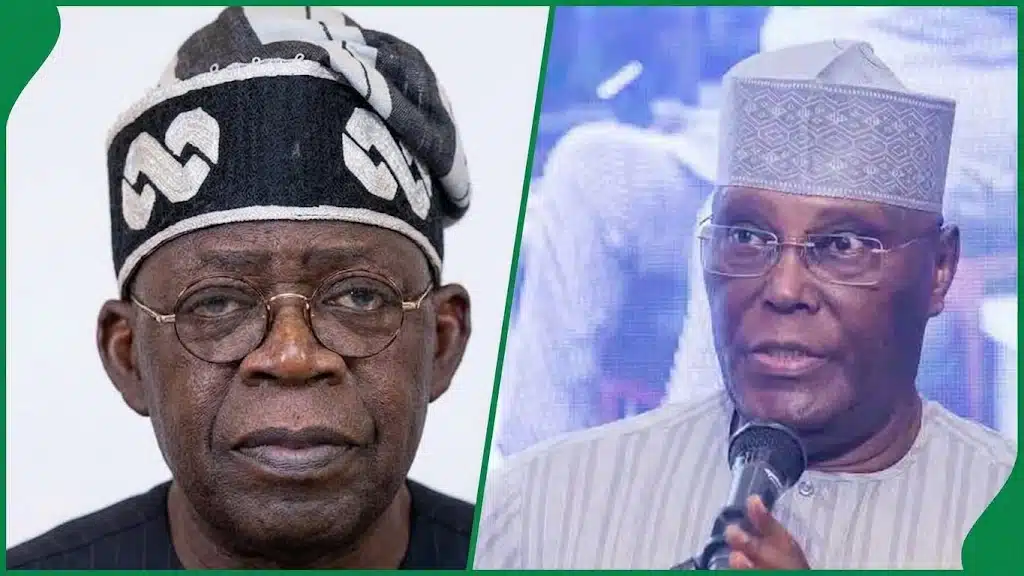
Former Vice President and African Democratic Congress (ADC) presidential candidate, Atiku Abubakar, has criticised President Bola Tinubu over his allegation that opposition parties are responsible for hunger and poverty in Nigeria, describing the claim as delusional.
Atiku argued that the President’s remarks amounted to an attempt to evade accountability for the economic difficulties Nigerians have experienced under his administration.
He maintained that Tinubu could not introduce policies that worsened living conditions and subsequently accuse other political actors of causing the resulting hardship.
In a statement made available to Naija News on Saturday by Phrank Shaibu, Director of Strategic Communication of the ADC Presidential Campaign Council, Atiku faulted the President for shifting responsibility for the country’s economic challenges to the opposition.
The former vice president said the All Progressives Congress (APC) had governed Nigeria for eight years before Tinubu assumed office, adding that the party had remained in power for approximately three and a half years under the current administration.
He argued that Nigerians were aware of the political party responsible for governing the country and could independently assess the effects of its policies.
Atiku urged Tinubu to stop making statements he considered dismissive of citizens’ concerns and instead address questions surrounding his administration’s economic performance.
He insisted that the difficulties facing Nigerians were evident and could not be dismissed through accusations against opposition parties.
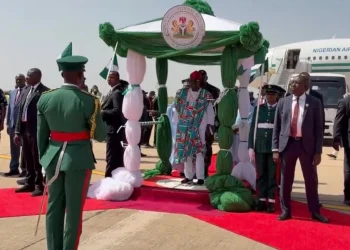
The ADC presidential candidate also questioned the President’s decision to commission the Abuja-Kaduna Expressway while the project remained incomplete, arguing that the action demonstrated a disconnect between the government and the everyday experiences of citizens.
According to Atiku, public infrastructure projects should be completed before being presented as achievements, stressing that speeches and ceremonial events could not substitute for actual delivery.
He further challenged the administration to explain the consequences of its economic decisions, particularly the removal of petrol subsidies and the depreciation of the naira.
Atiku questioned which government implemented the subsidy removal and presided over the currency’s decline from approximately ₦471 to ₦1,329 against the United States dollar.
He also cited estimates attributed to the World Bank, which projected that 63 per cent of Nigerians would be living below the national poverty line in 2026, as evidence of the severity of the country’s economic challenges.
The former vice president raised concerns over the extension of the 2024 budget into 2025 alongside the implementation of a separate budget for the same year.
He also demanded explanations regarding ₦7.13 trillion reportedly recorded under energy security in 2024 and questions surrounding ₦11.2 trillion in NNPC pipeline-related expenditure.
Atiku called for transparency over the allocation and utilisation of the funds, insisting that Nigerians deserved clear information about the beneficiaries and the projects executed.
Additionally, he questioned an alleged $12.4 billion discrepancy identified in Nigeria’s external accounts for the first half of 2026.
He also sought clarification regarding the reported payment of $22.5 million in other charges associated with the Abu Dhabi financing facility.
Atiku maintained that the Tinubu administration should address these financial concerns and provide Nigerians with explanations about its economic decisions rather than blaming opposition figures for the country’s difficulties.
He reiterated that the government must accept responsibility for its policies and demonstrate measurable improvements in the living conditions of citizens.