

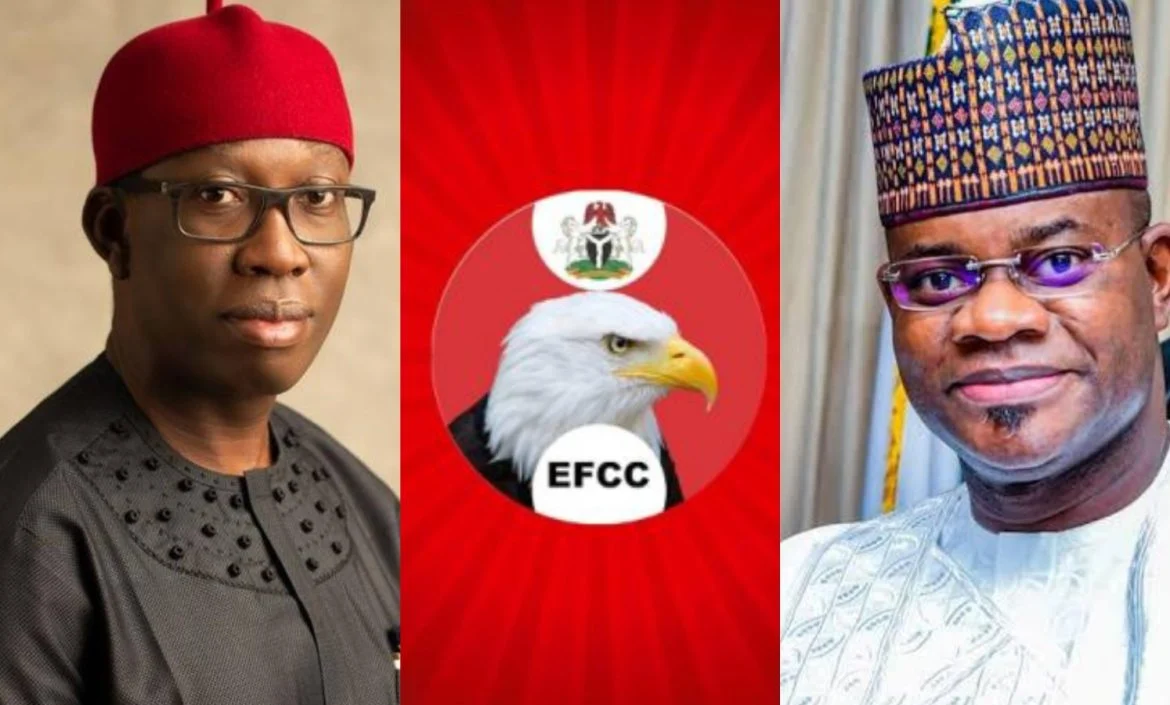
The Economic and Financial Crimes Commission (EFCC) has come under renewed pressure to complete its inquiries into former Delta State Governor Ifeanyi Okowa and ex-Kogi State Governor Yahaya Bello, with demands that either politician be taken to court if investigators uncover adequate evidence of wrongdoing.
Politics Nigeria reports that the Human Rights Writers Association of Nigeria (HURIWA) issued the appeal in a statement released on Friday by its National Coordinator, Emmanuel Onwubiko.
The organisation called on the anti-corruption agency to disclose the progress made in both investigations and clarify whether the findings so far justify additional legal proceedings.
According to HURIWA, Nigerians have a right to receive reliable information about corruption-related inquiries involving former government officials, especially when allegations have remained under public scrutiny for lengthy periods without a definitive outcome.
The rights group argued that the commission should take appropriate action whenever the available evidence warrants prosecution. However, where investigators cannot establish sufficient grounds for a criminal case, the agency should communicate its position clearly.
HURIWA further warned against allowing investigations to drag on without resolution, noting that government institutions must uphold transparency and public accountability while respecting the constitutional principle that every accused person is presumed innocent until proven guilty.
The latest appeal follows continuing public interest in allegations concerning the handling of government resources during the administrations of both former governors.
Okowa’s Case and Questions Surrounding Derivation Revenue
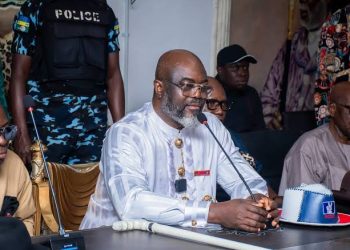
Okowa, who served as Delta State governor between 2015 and 2023, was reportedly arrested and detained by the EFCC in November 2024 over allegations connected to the management of financial allocations received during his eight-year administration.
Information referenced by HURIWA indicated that the former governor visited the commission’s Port Harcourt office after being summoned by investigators but was subsequently taken into custody.
At the time, the EFCC reportedly explained that Okowa had appeared at the office in response to an invitation from officials investigating the allegations against him before his arrest.
The inquiry was said to have focused on approximately ₦1.3 trillion in revenue received through the 13 per cent derivation arrangement from the Federation Account between 2015 and 2023.
Under Nigeria’s revenue-sharing framework, the derivation principle provides additional allocations to states where natural resources, particularly crude oil, are produced.
The funds are intended to benefit oil-producing states and form part of the country’s broader system for distributing revenue generated from natural resources.
Questions surrounding the administration of these allocations have contributed to scrutiny of Okowa’s tenure, with investigators examining issues relating to the handling of the substantial sums involved.
HURIWA’s latest intervention places renewed emphasis on the need for the commission to establish the status of the investigation and communicate its findings to the public.
The organisation maintained that concluding the inquiries would help address public concerns, prevent uncertainty from persisting and demonstrate that allegations involving former public officials are handled in accordance with the law.
It also reiterated that any decision to prosecute must be supported by credible evidence, while investigations that do not produce sufficient grounds for charges should receive an appropriate explanation.
The association’s position is that neither case should remain unresolved indefinitely, stressing that accountability, fairness and respect for due process must guide the EFCC’s handling of both matters.