

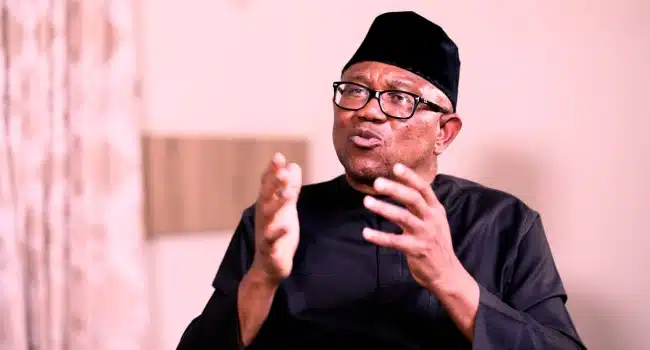
Peter Obi, the presidential candidate of the Nigeria Democratic Congress (NDC), has attributed many of the difficulties confronting Nigeria to the actions and conduct of political leaders.
Obi maintained that the country itself is not responsible for the numerous challenges facing citizens, arguing instead that the major problem lies with those entrusted with the responsibility of governing the nation.
The former Anambra State governor made the remarks during a visit to Koinonia Global and Eternity Network International, where he addressed worshippers during a Sunday service.
Obi was invited to participate in the worship programme by Apostle Joshua Selman, the leader of the church. His appearance before the congregation reportedly attracted considerable attention as he spoke about Nigeria’s political situation and the role of leaders in shaping the country’s future.
While addressing the congregation, Obi said Nigerians should not only pray for the nation but should also remember political leaders in their prayers.
He appealed to the worshippers to pray that politicians would abandon corruption and stop diverting resources meant for the development of the country.
According to him, the persistent problems affecting Nigeria cannot solely be blamed on the nation itself because the country possesses the resources and potential required to succeed.
Obi argued that the real challenge is the manner in which public affairs are handled by those occupying positions of authority.
He urged Nigerians to avoid creating divisions by portraying some politicians as completely good and others as entirely bad. Instead, he said citizens should recognise that politicians collectively bear responsibility for the condition of the country.
The former presidential candidate also called for divine intervention in the political system, asking the congregation to pray that God would influence leaders to make better decisions and refrain from misappropriating public resources.
Obi further reflected on Nigeria’s development compared with that of other countries that were at a similar level of progress decades ago but have since achieved significant economic and social advancement.
He encouraged Nigerians to examine the experiences of such nations to understand how responsible leadership, accountability and proper management of public resources can transform a country.
Referring to the book Growing Apart, Obi urged citizens to study the factors responsible for the widening gap between countries that have progressed rapidly and those that have struggled to achieve comparable development.
He said his personal experiences and observations from other parts of the world had shown him that development is possible when leaders and citizens work together and public institutions function effectively.
Obi stressed that Nigeria has the human and natural resources required to become a prosperous nation, but the country can only realise its potential if public officials put national interests above personal gain.
He appealed to those entrusted with managing government resources to desist from embezzlement and other forms of financial misconduct.
The politician expressed optimism that Nigeria could experience substantial improvement if leaders began to prioritise transparency, accountability and responsible governance.
He maintained that meaningful progress would become achievable if those in positions of authority committed themselves to doing what is right and using public resources for the benefit of the wider population.
Obi concluded by encouraging Nigerians to continue praying for the country and its leaders, stressing that political transformation requires both responsible leadership and a genuine commitment to national development.