

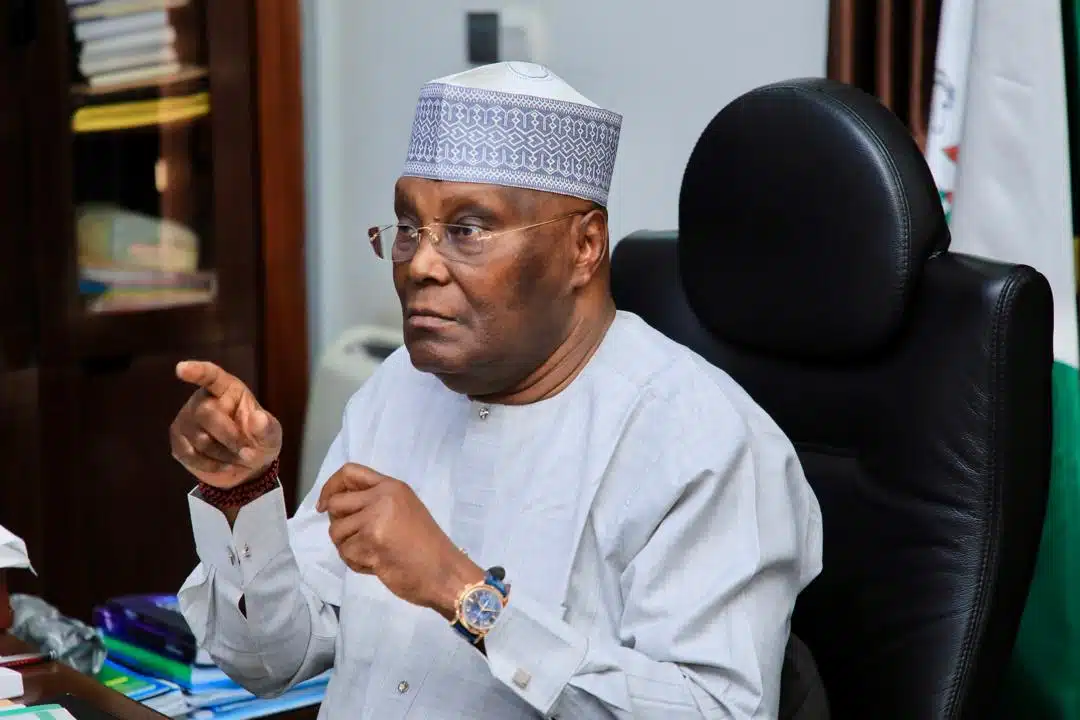
The Presidency has responded to former Vice-President Atiku Abubakar’s promise to reopen Nigeria’s land borders if elected president in 2027, questioning the specific border restrictions he intends to lift.
Atiku, who is contesting the 2027 presidential election under the platform of the African Democratic Congress (ADC), had said his administration would restore full access through the country’s land borders as part of efforts to encourage regional commerce and strengthen businesses engaged in cross-border activities.
However, the Federal Government has argued that a significant number of Nigeria’s land borders are already operational.
Sunday Dare, Special Adviser to President Bola Tinubu on Media and Public Communication, stated that the government had reopened most of the country’s land borders on March 14, 2024.
Dare also drew attention to President Tinubu’s reopening of the Kamba border in Kebbi State on February 14, 2026. According to him, the development had generated positive economic and diplomatic outcomes for Nigeria.
Responding to Atiku’s campaign promise, the presidential aide questioned what the former vice-president meant by reopening the borders, given the measures already taken by the present administration.
Dare suggested that if Atiku was referring to a relaxation of existing controls, he should clearly identify the restrictions he intends to remove and explain how his proposed policy would address potential security risks.
He argued that Nigeria could not afford to sacrifice national security in the pursuit of increased commercial activity, particularly at a time when criminal networks and terrorist groups increasingly operate across national boundaries.
According to Dare, the concept of an open border should not be confused with a border without regulation. He explained that contemporary border management systems are intended to allow legitimate travellers, traders and businesses to operate efficiently while ensuring that criminal elements are prevented from exploiting border routes.
He said effective border administration was particularly important because the same routes used for lawful trade and movement could also be exploited for activities such as terrorism, arms smuggling, human trafficking and other organised crimes.
The presidential adviser further maintained that Nigeria’s changing security environment made strong border surveillance an essential part of protecting the country.
He noted that domestic security threats were increasingly developing links beyond Nigeria’s borders, making cooperation, monitoring and effective control at entry and exit points more important.
Dare also challenged politicians to ensure that their campaign promises concerning sensitive national issues are supported by clear policies and accurate information.
While acknowledging that political parties and candidates have the right to present alternative visions for the country, he insisted that discussions surrounding national security and economic management should be based on facts and a clear understanding of existing government institutions and policies.
The Presidency’s response therefore appears aimed at seeking greater clarity from Atiku on how his proposed border policy would differ from measures already implemented by the Tinubu administration.
Dare maintained that facilitating legitimate trade and movement remained compatible with maintaining strong security systems, arguing that Nigeria’s borders could be economically accessible without becoming vulnerable to criminal networks.
He urged political actors to present Nigerians with practical and credible alternatives rather than making broad promises without explaining how such policies would be implemented or how their possible security consequences would be addressed.