

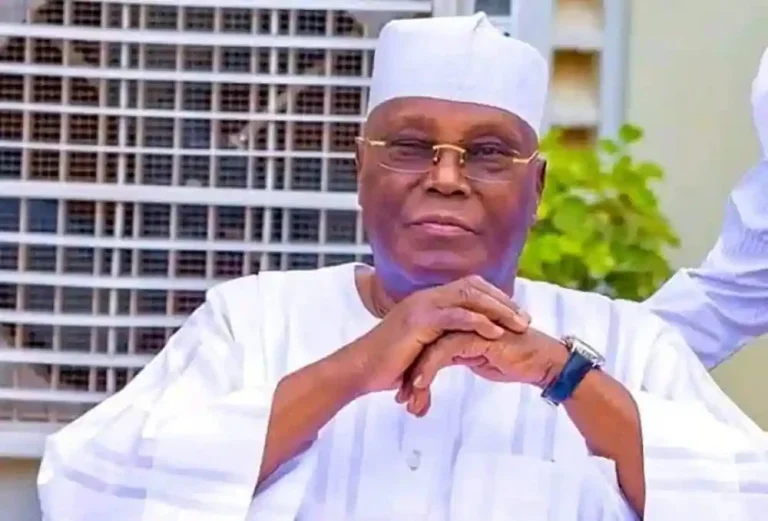
Former Vice President and presidential candidate of the African Democratic Congress (ADC), Atiku Abubakar, has criticised President Bola Tinubu’s plan to work with state governors to reduce public transport fares, describing the move as a late response to the cost-of-living crisis.
Atiku, in a statement issued by his Senior Special Assistant on Public Communication, Phrank Shaibu, also faulted the Federal Government’s progress on Compressed Natural Gas (CNG) conversion, saying the figures released by the administration reflected what he described as policy failure.
According to Atiku, only about 120,000 vehicles have been converted to CNG in more than three years, representing less than one per cent of an estimated 14 million vehicles on Nigerian roads.
He argued that the figure could not be presented as a major achievement, particularly as Nigerians continue to grapple with high transport fares, food prices and other rising living costs.
“If Tinubu’s grand strategy for cushioning the consequences of his reckless and poorly thought-out subsidy removal is CNG conversion, then the admission that only about 120,000 vehicles have been converted in more than three years is not an achievement. It is an advertisement of policy failure,” Atiku said.
He further criticised Tinubu’s recent position that cheaper fuel should translate into cheaper transportation, arguing that the government had failed to address the purchasing-power crisis affecting Nigerians.
Atiku said the removal of petrol subsidy, without what he described as an adequate cushioning framework, had contributed to rising transport and food costs while placing additional pressure on households and businesses.
He also accused the administration of attempting to introduce relief measures as the 2027 election approaches after Nigerians had endured years of economic hardship.
According to him, CNG could reduce the operating cost of converted vehicles but would not necessarily make transportation affordable for Nigerians whose incomes have been eroded by inflation.
“CNG can make a converted bus cheaper to operate. It cannot make a poor Nigerian richer,” he said.
The former vice president said the government’s transportation policy should focus not only on reducing the cost of operating vehicles but also on improving the purchasing power of citizens.
He cited the rising cost of transportation for workers, students, farmers, traders and businesses as evidence of the wider economic challenges facing the country.
Atiku also questioned the government’s plan to begin providing further relief from October 1, arguing that Nigerians were already facing the effects of high transport and food costs.
“Nigerians are hungry today. Transport is expensive today. Food is expensive today. Businesses are dying today. Why must relief arrive by appointment?” he asked.
The ADC candidate renewed his call for what he described as a targeted and transparent fuel subsidy linked to domestic production.
He said such a policy should be fiscally capped, independently audited and structured to ensure that the benefits reach commuters, farmers, workers, traders and small businesses rather than politically connected individuals.
Atiku also promised to support domestic refining, track crude production and reduce energy costs if elected president.
He contrasted his proposal with the Tinubu administration’s approach, accusing the government of creating economic hardship and subsequently relying on palliatives to cushion its effects.
“That is the difference between Tinubu and Atiku: Tinubu manufactures hardship and distributes palliatives. Atiku will attack hardship at its source,” he said.
Atiku maintained that the central question for Nigerians should not simply be how cheaply a bus can operate, but how affordable everyday life has become for citizens.
He concluded by declaring that Nigerians had endured enough economic hardship under the Tinubu administration and called for a change of government in 2027.