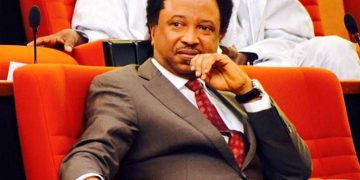


Former Kaduna Central Senator, Shehu Sani, has described former Vice President Atiku Abubakar’s promise to restore fuel subsidy if elected president in 2027 as deceptive, arguing that returning to the policy would be impracticable and harmful to Nigeria’s economy.
Speaking at a press conference in Abuja, Sani said Nigeria could not afford to return to a subsidy regime that had cost the country trillions of naira, while also encouraging corruption and fuel smuggling.
He said political leaders should instead focus on revamping the country’s refineries and ensuring that Nigeria refines its crude oil locally.
According to Sani, Nigeria previously spent between N3 trillion and N4 trillion on subsidising petroleum products, a situation he described as economically unsustainable for an oil-producing country.
“I don’t think any candidate that is worthy of leadership should pull us back to that era,” he said.
Sani alleged that the subsidy regime had been abused by individuals who diverted public funds under the guise of importing petroleum products. He also argued that subsidised fuel was often smuggled into neighbouring countries, where it was sold at higher prices, thereby undermining the intended benefits of the policy.
The former senator questioned the logic behind Nigeria exporting crude oil, importing refined petroleum products and then spending scarce foreign exchange to subsidise those same products.
“If any politician makes pledges of revamping our refineries so that we can be able to refine our own crude oil, then he’s making sense,” Sani said.
“But a politician that has been in the economic field for a very long time telling us that the way forward for us as an oil-producing country is to continue to import all petroleum products and again use our own foreign currency to subsidise it for our people to consume, for how long can we continue to do that?”
While acknowledging the hardship caused by the removal of fuel subsidy, Sani maintained that returning to the old system was not the solution.
“The return of subsidy will not bring down the prices of commodities. It will simply distort the economic stability of our country,” he said.
He urged the Federal Government to give its economic reforms a “human face,” insisting that Nigerians should not be made to bear the full burden of the policies while political leaders continued to enjoy extravagant lifestyles.
According to him, the government must reduce the cost and size of governance, while leaders at both the executive and legislative levels should also make sacrifices to demonstrate that the burden of economic reforms was being shared.
Sani further called for increased investment in domestic refining, citing the Dangote Refinery as an example of the benefits of refining petroleum products within the country.
He questioned why Nigeria should continue to rely heavily on imported fuel when a major private refinery had already been established in the country.
“We should not just talk about importing petroleum products,” he said, stressing that Nigeria could not achieve meaningful economic independence while it continued to export raw materials and import finished products.
Turning to the 2027 general elections, Sani urged political parties and candidates to focus their campaigns on issues, policies and programmes rather than ethnic, religious or sectional sentiments.
He warned that using ethnicity and religion to attack political opponents could further undermine national unity and stability.
“At this time of our country’s life, we should assess, analyse, and elect leaders based on what they stand for and what they can deliver for us as a country,” he said.
Sani also criticised opposition politicians seeking foreign support or intervention in Nigeria’s political affairs, arguing that political parties should focus on convincing Nigerian voters rather than seeking validation from foreign governments or institutions.
He expressed optimism that Nigeria’s democracy, having survived several periods of crisis, could conduct a transparent and credible election in 2027.
The former senator, however, raised concerns over what he described as negative predictions about Nigeria’s future ahead of the election, urging political actors to place the country’s unity and stability above their personal ambitions.
On the issue of power rotation, Sani said he supported the emergence of a southern presidential candidate in 2027, arguing that political power should rotate among the country’s regions to promote balance and national stability.
He explained that while power rotation was not a constitutional requirement, it remained an important political understanding in a country as diverse as Nigeria.
Sani also declared his support for President Bola Ahmed Tinubu’s re-election bid and urged opposition parties to consider fielding a southern candidate in the 2027 presidential election.
He cautioned politicians against treating elections as a matter of life and death, stressing that the country’s unity should not be sacrificed because of political ambitions.
“The country doesn’t have to fall because you lose elections. The country doesn’t have to scatter into pieces because you lose elections,” he said.
Sani added that political leaders must recognise Nigeria’s ethnic and religious diversity and manage political disagreements responsibly to avoid actions capable of threatening the country’s peace, unity and stability.