


A rare moment of bipartisan consensus emerged on Thursday as lawmakers and opposition party leaders praised President Bola Tinubu and Minister of Works David Umahi for the quality of ongoing and completed federal road projects across the country.
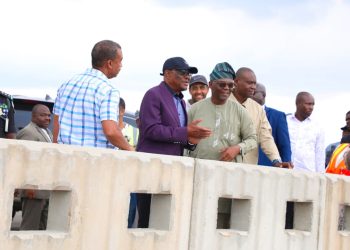
Their commendations came during an inspection tour of the Mararaba Keffi expressway and the Abuja Kaduna Kano highway, where many said the standard of work surpassed expectations and reflected improvements not seen in decades.
Segun Showunmi, a prominent member of the Peoples Democratic Party (PDP), expressed satisfaction with the level of construction on the Abuja–Kaduna–Kano corridor.
According to him, the road when completed would offer Nigerians long-term relief and improved mobility.
Showunmi added that Minister Umahi’s commitment to tackling longstanding infrastructure challenges was evident on the ground, and his personal endorsement encouraged other observers to reassess the quality of federal road projects.
Kanti Uthman of the African Democratic Congress (ADC) also applauded the progress recorded.
“As an architect, I can confidently say this work meets global standards. When something is done well, we must acknowledge it regardless of party lines,” he said.
Other opposition figures, including Musa Zubair of the Action Alliance (AA) and Sunday Ayeni of the New Nigeria People’s Party (NNPP), also commended the workmanship and pledged to brief Nigerians on the developments they witnessed.
Members of the Senate Committee on Works echoed the same sentiment. One committee member described Umahi as “the right man for the job,” adding that the minister had earned the confidence of both the legislature and the public.
Abiodun Essiet, Senior Special Assistant to the President on Community Engagement (North-Central), described the Abuja–Kaduna–Kano highway as a legacy project that demonstrated the administration’s commitment to durable and transparent infrastructure delivery.
He noted that opposition stakeholders were invited deliberately to ensure accountability and public trust.
During the tour, Minister Umahi expressed satisfaction with the pace and quality of construction, while explaining design adjustments that became necessary after the initial contract valued at ₦73 billion was found to have shortcomings.
He revealed that only 44 kilometres could be fully executed under the original arrangement, prompting emergency repairs and an additional 20-kilometre extension following improved performance.
Providing further breakdowns, Umahi said:
-
Section One (118 km) costs about ₦252 billion, with 50% already paid.
-
17 km near Kano are being completely rebuilt.
-
A 12-km solar-lit extension is nearing completion.
-
Sections One and Three already have 8 km of finished concrete pavement.
-
Section Two spans 72 km, primarily concrete, and is valued at ₦502 billion.
He emphasised that the administration opted for reinforced concrete for longevity.
“If this were asphalt over 260 kilometres, we could finish it in nine months. But reinforced concrete roads last between 50 and 100 years. That is why we ask Nigerians for patience,” he said.
Umahi noted that the ministry had used six months out of the allocated 14-month timeline and was determined to deliver a durable project that meets global engineering standards.

**backbiome**
Mitolyn is a carefully developed, plant-based formula created to help support metabolic efficiency and encourage healthy, lasting weight management.