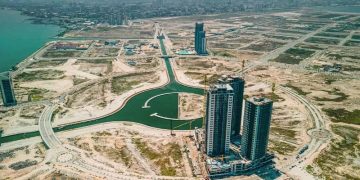


A new market review has ranked Eko Atlantic, Ikoyi, Banana Island, and Victoria Island as Nigeria’s most expensive residential areas, with Lagos maintaining its position as the epicenter of luxury real estate.
The 2025 Nigerian Residential Market Review by Diya Fatimilehin & Co highlights Lagos as the nation’s dominant housing market, where prime locations continue to command record-breaking prices. For instance, a four-bedroom flat in Ikoyi now sells for around N1.5 billion. However, the report also notes that states like Ogun and Oyo are emerging as viable alternatives, benefiting from infrastructure expansion, proximity to Lagos, lower costs, and abundant land for development. In Ibadan, upscale areas such as Alalubosa and Iyaganku GRAs, as well as Laderin Estate and Olusegun Osoba Hilltop in Abeokuta, are attracting significant interest, with some homes renting for as high as N3 million annually.
The report links this growth to major infrastructure projects that are reshaping urban connectivity. Completed or ongoing works include the Lagos Blue and Red Line Metro rails, the Lagos-Ibadan Expressway, a flyover at Oke-Fia in Osun, Oyo’s 110 km Rashidi Ladoja Circular Road, and the 71 km Ondo section of the Lagos-Calabar Coastal Highway. Upcoming projects such as the Fourth Mainland Bridge, Lagos Green Line Metro Rail, and the Lekki International Airport are also expected to stimulate further development.
According to the review, every region in Nigeria reflects unique dynamics in its residential landscape, influenced by history, culture, economics, and infrastructure. Since independence in 1960, rapid urbanization has shaped the country’s housing market. Lagos struggled with an influx of migrants, Port Harcourt expanded during the oil boom, while Abuja witnessed a construction surge after becoming the Federal Capital Territory. More recently, structural reforms,such as subsidy removal, exchange rate unification, tax changes, road improvements, and agricultural mechanization,have been opening new investment frontiers in emerging cities.
In the North-West, Nigeria’s industrial and agricultural hub, urban centers like Kano, Kaduna, Zaria, Sokoto, Katsina, and Birnin Kebbi are poised for growth as mechanization drives production and attracts a youthful workforce. Infrastructure projects boosting this trend include the N6.4bn Gwaram Basirka Bridge and 21 mini-grid power projects in Jigawa, the 5.5 km Airport Road and Rafin Guza-Hayin Naiya-Kukumake Road in Kaduna, as well as the Kauru-Pambegua and Tundun Biri Roads. Kaduna is also developing a Millennium City in partnership with Qatar Construction Company, alongside a new 300-bed specialist hospital. Despite persistent insecurity in parts of the region leading to high vacancy rates, demand remains strong in established areas like Barnawa and Ungwan Rimi in Kaduna, Nasarawa GRA and Race Course Road in Kano, and Adau Aliero Housing Estate in Birnin Kebbi. Emerging hotspots include Kamazao and Karji in Kaduna, and Gwarzo and Tudun Yola in Kano.
In the oil-rich South-South, dependence on crude oil continues to expose the region to boom-and-bust cycles. Nonetheless, investor confidence is fueling urban renewal in Port Harcourt, Uyo, and Asaba. Key projects include the 23.2 km Ikot Ekaide-Ikot Okoro-Ikot Ibritam Road and the 12.28 km Ikot Ubo-Odot Road in Akwa Ibom, the Lagos-Calabar Coastal Highway in Cross River, and the 67 km Alesi Ugep Road. Rivers State has launched the 94 km dualised East-West Road in Eleme, while Benin City is nearing completion of a 169-room Radisson Hotel.
The review concludes that while Lagos remains the heart of luxury housing, infrastructure investment, economic reforms, and shifting demographics are broadening Nigeria’s residential market and creating new growth corridors across the country.