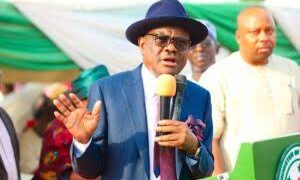


Minister of the Federal Capital Territory (FCT), Nyesom Wike, has questioned the sincerity of Peter Obi’s visits to internally displaced persons (IDP) camps, alleging that some politicians use public displays of compassion to attract voters ahead of the 2027 general election.
Wike made the remarks on Thursday in Abuja at the first Idoma Hall of Fame induction ceremony, organised in collaboration with Ochetoha K’Idoma as part of the Idoma Centenary Plus celebration.
The FCT minister’s comments came amid a growing political exchange involving Obi, the presidential candidate of the Nigeria Democratic Congress (NDC), Vice-President Kashim Shettima and former Kano State governor Rabiu Kwankwaso.
While Wike questioned the motivation behind Obi’s visits to IDP camps, Shettima had criticised the former Anambra State governor’s comparisons between Nigeria and other countries. Kwankwaso, however, defended Obi’s use of development statistics, describing his knowledge of figures from Nigeria and other parts of the world as an advantage.
Wike questions Obi’s motives
Speaking at the event, Wike challenged the perception of Obi as a humble politician, citing the former Anambra governor’s visits to IDP camps, including a visit to Plateau State in 2023 to mark his 62nd birthday.
The minister questioned why Obi, whom he said had not celebrated his birthday in that manner while serving as governor, chose to mark the occasion at an IDP camp while pursuing the presidency.
“Politicians can tell lies,” Wike said. “A man who did not celebrate his birthday when he was a governor now wants to be president and wants to celebrate his birthday in IDP camps? And you say, ‘Oh, he is very humble’. Which humility is that?”
Wike’s remarks suggested that politicians’ public gestures of solidarity with vulnerable communities should not automatically be taken as evidence of genuine humility or commitment to their welfare.
However, he did not present evidence establishing that Obi’s visits were motivated by political gain. His comments reflected his criticism of the former governor’s approach to public engagement.
Obi has recently said he visited 12 IDP camps across the country in recent weeks. During a visit to the Ramin Kura IDP camp in Sokoto State, he shared photographs of himself interacting with children and described the visit as his 12th.
The NDC presidential candidate has also called on the government to improve conditions in the camps, while urging political office holders to spend their holidays in Nigeria to experience the difficulties confronting vulnerable citizens.
His visits have drawn attention to the circumstances of displaced people and the responsibilities of government in providing security, shelter and other essential services.
Wike, however, urged Nigerians to look beyond public displays of modesty when assessing politicians seeking elective office.
Minister criticises politicians’ public gestures
The FCT minister broadened his criticism to include politicians who, in his view, suddenly adopt everyday habits or visit public places to create an impression of solidarity with ordinary Nigerians.
He cited politicians who buy roasted corn and groundnuts by the roadside or visit filling stations to comment on fuel prices, questioning whether such gestures accurately reflected their usual conduct or demonstrated a genuine understanding of the public’s difficulties.
“You see a man who has never bought corn on the road suddenly buying corn and groundnuts in public. Who are you deceiving?” he asked.
Wike’s comments appeared directed at political figures whose public appearances are intended to portray them as connected to the daily struggles of ordinary citizens.
His argument was that voters should evaluate politicians based on their records, decisions and capacity to address public concerns rather than relying solely on images or gestures that may generate sympathy.
The minister did not name every politician he had in mind when referring to such public displays.
Wike urges Nigerians to assess Tinubu administration
Wike also called on Nigerians to assess the performance of the current administration against the conditions that existed before it assumed office.
Acknowledging that the country continued to face economic and security challenges, he argued that voters should consider whether efforts were being made to improve the situation before deciding which political party or candidate to support in 2027.
“Nobody is happy that we are where we are. But if we are to trace our steps back to where we are coming from, are there attempts to improve the situation?” he said.
The minister urged Nigerians to reject politicians he described as “gamblers” as political activities intensify ahead of the next general election.
His remarks amounted to a defence of the need to assess the current administration in the context of the challenges it inherited and the measures it has taken to address them.
However, the question of whether those measures have delivered sufficient improvements remains a central point of political debate, particularly as opposition parties seek to make economic hardship, insecurity and the cost of living key issues in the 2027 campaign.
Shettima mocks Obi’s international comparisons
Wike’s comments came a day after Vice-President Kashim Shettima criticised Obi’s comparisons between Nigeria and other countries, particularly Bangladesh.
Shettima spoke on Wednesday at the inauguration of the All Progressives Congress (APC) Presidential Campaign Council at the State House Banquet Hall, Presidential Villa, Abuja.
Describing Obi as “my very good friend”, the vice-president used a clothing-size analogy to argue that the former Anambra governor’s comparisons did not adequately account for the differences between Nigeria and other countries.
“He seems convinced that a size 36 shirt tailored for Bangladesh will somehow fit Nigeria’s size 52 frame,” Shettima said.
The remark was a criticism of Obi’s approach to comparing countries’ economic and development performance. Shettima’s analogy suggested that policies or development models associated with one country could not automatically be applied to Nigeria without accounting for differences in population, economic structure and other national circumstances.
The exchange highlights a broader debate over the use of international comparisons in evaluating Nigeria’s development prospects and the performance of its leaders.
Such comparisons can provide useful benchmarks, but their significance depends on the indicators being examined, the periods being compared and the differences between the countries involved.
Kwankwaso defends Obi, faults Shettima’s remarks
Kwankwaso subsequently criticised Shettima’s comments, saying he was not surprised by the vice-president’s response to Obi.
Speaking during an interview on Channels Television on Thursday, the former Kano governor defended Obi’s use of development statistics and said he had examined the figures the NDC presidential candidate had cited.
“What else would you expect him to say?” Kwankwaso asked.
He said that, in his assessment, most of the figures Obi had presented were correct, although he acknowledged that people could make mistakes or experience slips of the tongue.
“You see, I always listen to him (Obi). Like all others, I take time to check the statistics. As far as I’m concerned, most of the figures he was reeling out were correct.
“And the only thing is, because as human beings, we are bound to make mistakes or slip of tongue, as they call it. But for him to come and make that statement, I don’t think he was correct,” Kwankwaso said.
Kwankwaso also praised Obi’s familiarity with development statistics, arguing that knowledge of economic and social indicators from Nigeria and other parts of the world could be an advantage for someone seeking the presidency.
“So I am happy that our presidential candidate is somebody who is conversant with the statistics not only in this country but all over the world, in Europe, in Asia, everywhere. And I think that is a good thing,” he added.
His remarks amounted to a defence of Obi’s use of international data, while challenging Shettima’s criticism of the former governor’s comparisons.
Kwankwaso’s endorsement of the figures, however, represents his assessment of Obi’s claims. Establishing their accuracy requires examining the specific statistics, their original sources and the context in which they were presented.
Political exchanges intensify ahead of 2027
The comments by Wike, Shettima and Kwankwaso illustrate the intensifying political debate ahead of the 2027 general election, with competing camps seeking to challenge one another’s credibility, policy arguments and public image.
Wike’s criticism focuses on whether politicians’ public displays of compassion reflect genuine concern for vulnerable Nigerians or are intended to improve their electoral prospects. Shettima’s remarks centre on Obi’s use of international comparisons, while Kwankwaso has defended the NDC candidate’s familiarity with development statistics.
Beyond the political exchanges, the issues raised touch on questions of accountability, economic performance, displacement and the responsibilities of public office holders.
For voters, the central questions will include how candidates propose to improve conditions in IDP camps, strengthen national security, address economic hardship and use reliable evidence to support their policy proposals.
As the 2027 election approaches, the competing parties and political figures are likely to face increasing scrutiny over both their public statements and the practical plans they offer Nigerians.
Ultimately, voters will have to judge the candidates not only by their public appearances and campaign rhetoric, but also by the credibility of their claims, the feasibility of their proposals and their records of public service.