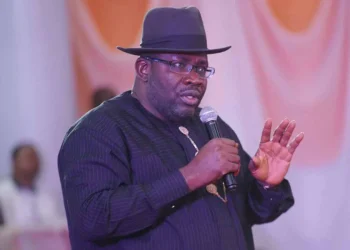


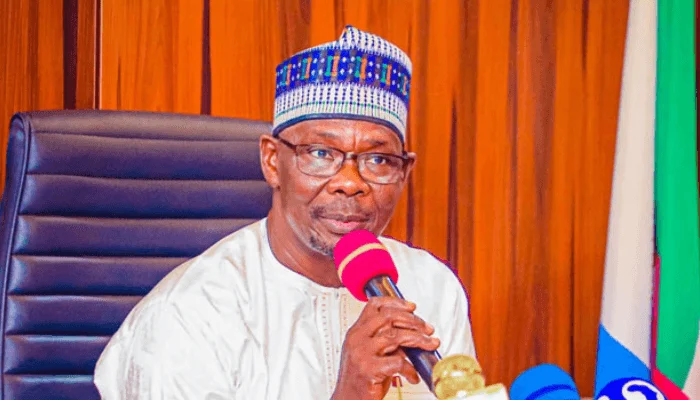
Nasarawa State Governor, Abdullahi Sule, has raised questions over the objective of the Rainbow Coalition being championed by the Minister of the Federal Capital Territory, Nyesom Wike, as political activities gather momentum ahead of the 2027 elections.
The governor spoke during a Tuesday interview with TVC, where he addressed the disagreement between Wike and some governors elected on the platform of the All Progressives Congress, APC.
Sule said he was pleased that Wike did not include him among the APC governors allegedly resisting the coalition.
He explained that Wike currently serves in President Bola Tinubu’s administration but remains a member of the Peoples Democratic Party, PDP, rather than the APC.
The Nasarawa governor subsequently sought clarification on the need for the proposed alliance, particularly given Wike’s stated intention to mobilise support for Tinubu while remaining outside the ruling party.
Sule also suggested that the position recently expressed by the APC Governors’ Forum may have been interpreted differently from what the governors intended.
Wike had earlier singled out three APC governors whom he accused of working against his political initiative.
Those named were Imo State Governor Hope Uzodimma, Kwara State Governor AbdulRahman AbdulRazaq and Ogun State Governor Dapo Abiodun.
The FCT minister, however, stated that the opposition he encountered did not involve all APC governors.
Wike has repeatedly explained that his coalition is intended to bring politicians from different parties together to back Tinubu’s 2027 presidential ambition.
The development has generated disagreement with the APC Governors’ Forum, which has warned against political arrangements that could weaken the ruling party or undermine its candidates during the forthcoming elections.
At a gathering in Abuja, the governors declared that they would neither participate in nor endorse any arrangement capable of damaging the APC’s interests.
Uzodimma, who heads the Progressive Governors’ Forum, communicated the position of the governors.
Their stance was widely viewed as a reaction to Wike’s efforts to build a cross-party political network around Tinubu.
The APC governors have maintained that support for Tinubu’s presidential bid should not involve establishing a separate political arrangement capable of affecting the party’s performance in governorship and legislative elections.
Wike has rejected such concerns, insisting that his political project is not designed to weaken the APC.
He has explained that while he intends to campaign for Tinubu at the presidential level, the PDP and other parties can still field their own candidates for governorship, Senate, House of Representatives and state assembly contests.
The minister has also argued that political allegiance can differ across various electoral contests.
According to Wike, the 2023 elections demonstrated that Nigerians could vote for one political party at the presidential level and another party when choosing legislative representatives.
He believes a comparable situation could emerge in 2027, with individuals supporting Tinubu for president while remaining loyal to their respective parties in other races.
Wike has therefore described the Rainbow Coalition as a broad political movement focused specifically on securing support for Tinubu, rather than a replacement for the APC.
He has equally dismissed suggestions that the initiative is intended to cause instability within existing political parties.
The controversy comes as political manoeuvring surrounding the 2027 elections continues to intensify.
Sule’s comments indicate that he does not consider himself part of the APC governors Wike accused of opposing the coalition, while his remarks also raise questions about the necessity of the arrangement.
Wike’s relationship with the APC-led administration remains notable because he continues to belong to the PDP while serving as a federal minister.
His support for Tinubu became prominent during the 2023 presidential election, when he was one of the five PDP governors who declined to support the party’s presidential candidate, Atiku Abubakar.
The current debate over the Rainbow Coalition reflects continuing discussions about cross-party cooperation and the extent to which politicians can support a presidential candidate while maintaining separate political affiliations and contesting other electoral positions under their respective parties.