

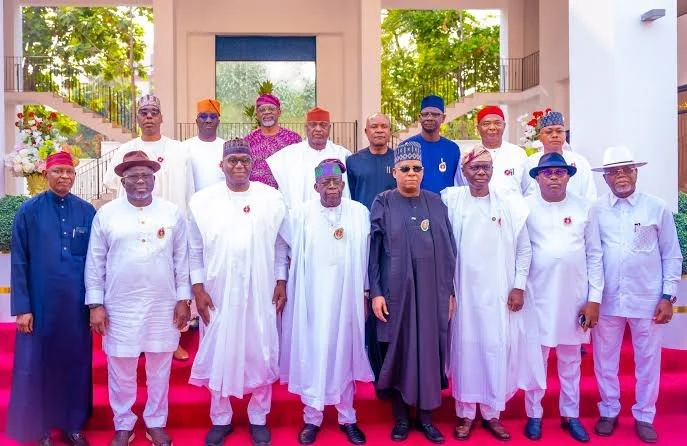
President Bola Tinubu on Thursday held a closed-door meeting with governors elected on the platform of the All Progressives Congress (APC) at the Presidential Villa, Abuja.
The meeting was the latest in a series of engagements involving the President, APC governors and other top party chieftains aimed at resolving the controversy surrounding the party’s Presidential Campaign Council (PCC) list released on Saturday, August 23, 2026.
The governors arrived at the President’s office shortly before 4pm after attending a separate meeting of the National Economic Council, chaired by Vice President Kashim Shettima.
The consultations, which began on Wednesday, focused on reviewing and making adjustments to the PCC list, which has generated controversy since its release.
The ruling party faced criticism over the inclusion of some controversial party chieftains, particularly individuals currently facing corruption charges. There were also allegations that key stakeholders within the party were not carried along in the compilation of the list.
Sources said discussions over the matter began at about 4pm on Wednesday and lasted until around 11pm but were not concluded, prompting the continuation of the meeting on Thursday following the regular National Economic Council meeting.
Although the full extent of the proposed changes had yet to be confirmed as of Thursday, sources close to APC governors and other party leaders said the list had been reviewed.
One source said the initial list had been deleted from the party’s X handle and that a revised version would be released after President Tinubu approves the deliberations and proposed changes.
“The list is part of the main agenda of the meeting. You can notice that the other controversial list has been deleted from the party’s X handle,” the source said.
Another party chieftain alleged that the APC was not fully carried along in the formation of the campaign council list.
According to the source, the President’s Special Adviser on Political Matters and a few individuals in the Presidency were responsible for compiling the initial list, which subsequently generated backlash within the party.
The source added that President Tinubu had taken charge of the matter and was expected to approve adjustments following the two-day consultation.
The review is also believed to be part of the party’s broader efforts to strengthen its political structure and improve its engagement with Nigerians ahead of the 2027 general elections.
The APC recently released the membership list of its 2027 Presidential Campaign Council, with President Tinubu named as chairman.
Vice President Kashim Shettima and APC National Chairman, Professor Nentawe Yilwatda, were appointed Vice Chairmen I and II, respectively. Senator Abdulaziz Yari was named Director-General, while Imo State Governor, Hope Uzodimma, was appointed Secretary.
The expanded council comprises 223 members and includes directorates covering finance, extractive industries, education, manufacturing and MSMEs, support group coordination, faith-based mobilisation, protocol, labour union relations, special duties, stakeholders’ mobilisation, community support, digital operations, grassroots engagement and welfare.
Following the controversy generated by the list, the Special Adviser to the President on Media and Public Communication, Sunday Dare, said adjustments would be made where necessary.
Dare maintained that the list remained valid, explaining that the campaign structure was not yet complete and that several subcommittees were still to be constituted.
He said the proposed subcommittees would provide an opportunity for more party members and political stakeholders to be accommodated within the campaign structure.
“As it is with every other list, there is room for subcommittees. Those subcommittees have not been formed, and many other names will come into those subcommittees,” Dare said.
He also insisted that the APC had not withdrawn the list but acknowledged that adjustments could still be made.
“The list is not cast in stone, just like every other list,” he added.
Dare, however, distinguished the planned changes from a full review of the campaign council, describing them as adjustments where necessary rather than a wholesale overhaul of the existing structure.