

The Economic Community of West African States (ECOWAS) has described West Africa as the most stable of Africa’s regional economic blocs despite the growing threat posed by terrorism and violent extremism.
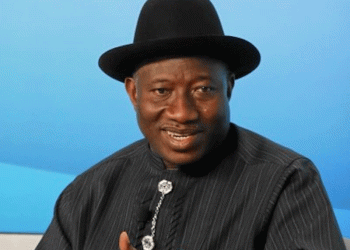
ECOWAS Commissioner for Political Affairs, Peace and Security, Ambassador Abdel-Fatau Musah, made the assessment in an interview with the News Agency of Nigeria (NAN).
Musah acknowledged that the region continues to face serious security challenges, particularly from terrorist groups and violent extremist organisations operating in parts of West Africa. However, he maintained that the sub-region had remained relatively stable compared with other parts of the continent.
The commissioner said the ability of West African countries to maintain relative stability despite the security threats was an indication of the resilience of the region and its institutions.
His comments come against the backdrop of persistent terrorist activities in parts of the Sahel and growing concerns about the possibility of violence spreading to other countries in the region.
The security situation has placed considerable pressure on governments, security agencies and regional organisations to strengthen cooperation and develop coordinated responses to terrorism and other forms of transnational crime.
Musah stressed the importance of continued regional cooperation in addressing the challenges confronting West Africa. He noted that the security situation requires collective efforts from member states rather than isolated responses by individual countries.
ECOWAS has continued to engage member states on issues relating to peace, security, political stability and regional integration.
The commissioner’s assessment also comes at a time when the regional bloc is dealing with significant political changes following the withdrawal of Burkina Faso, Mali and Niger from ECOWAS.
The three countries have formed the Alliance of Sahel States and have pursued their own regional security and political arrangements.
Despite these developments, ECOWAS has maintained its focus on protecting regional stability and strengthening cooperation among its remaining member states.
Security remains one of the major priorities for the organisation as terrorist activities continue to threaten communities and economic activities in parts of West Africa.
The spread of violent extremism has also raised concerns about its potential impact on trade, investment, agriculture and cross-border movement.
Experts have repeatedly stressed the importance of addressing the underlying factors that contribute to insecurity, including poverty, unemployment, weak institutions and limited opportunities for young people.
For ECOWAS, maintaining peace and stability is also important to the region’s economic development and integration agenda.
A stable security environment is considered necessary for businesses to operate effectively, for communities to engage in economic activities and for countries to attract investment.
Musah’s remarks therefore highlight the importance of preserving the relative stability that exists in much of the region while continuing to confront areas affected by terrorism.
The commissioner’s assessment does not suggest that West Africa is free from serious security problems. Rather, it reflects ECOWAS’s position that, despite the challenges, the sub-region remains comparatively stable within the broader African context.
The organisation is expected to continue working with member states and other partners to strengthen regional security cooperation and address emerging threats.
As terrorism and violent extremism remain major concerns, the ability of West African countries to maintain political stability and protect their populations will remain a key priority.
The ECOWAS position also underscores the need for sustained cooperation among governments, security institutions and regional bodies to protect peace and stability across the sub-region.