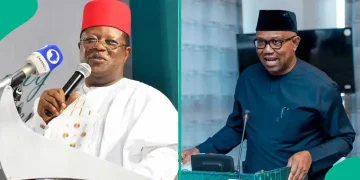


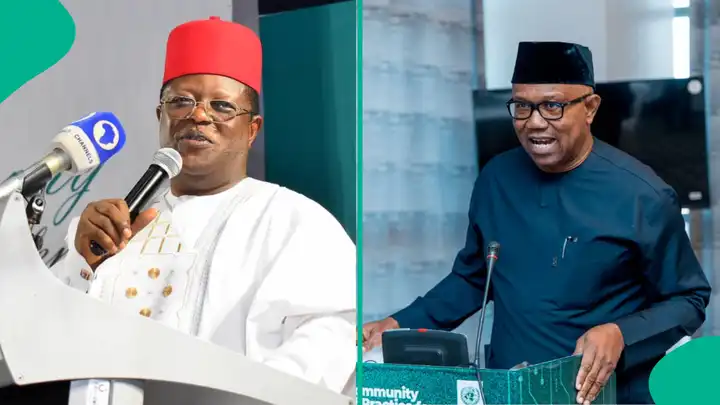
Minister of Works David Umahi has defended his decision to challenge former Anambra State Governor Peter Obi to a public debate, insisting the invitation was meant to compare governance records rather than discuss the 2027 presidential election.
Umahi’s reaction followed remarks made by Obi during an interview, where the former Labour Party presidential candidate dismissed the proposed debate. Obi argued that such engagements should only take place between individuals contesting the same office, suggesting that Umahi was not in the category of presidential contenders.
Responding through his Senior Special Assistant on Media, Francis Nwaze, the minister maintained that Obi misunderstood the purpose of the challenge. According to him, the debate was never intended as a political contest but as an opportunity for Nigerians to assess the performance of two former governors based on their achievements while in office.
Umahi said he found Obi’s refusal surprising, arguing that leadership performance should always be open to public evaluation regardless of political ambitions. He insisted that the conversation was about governance, accountability and development rather than preparations for the next general election.
The minister further claimed that Obi declined the invitation because he was uncomfortable with having his record directly compared with that of another former governor.
Highlighting his own experience in public office, Umahi noted that his career extends beyond serving two terms as governor of Ebonyi State. He pointed out that he currently serves as Nigeria’s Minister of Works, adding that his years in public service have provided a broader platform to demonstrate his leadership capacity.
In contrast, Umahi argued that Obi’s elective public service record is largely tied to his eight-year tenure as governor of Anambra State. He maintained that comparing their contributions to governance would enable Nigerians to form independent opinions based on verifiable projects and policy outcomes.
The minister also questioned the frequent praise Obi receives for leaving substantial financial reserves while in office. According to Umahi, prudent financial management should be assessed alongside visible development and completed infrastructure.
He argued that simply maintaining healthy government accounts should not be regarded as the sole indicator of successful leadership if critical projects remain unfinished or contractors are left unpaid.
To support his position, Umahi highlighted several projects undertaken during his administration in Ebonyi State, including the construction of roads, bridges, flyovers, schools and healthcare facilities. He added that his current role has also seen him oversee major federal road projects across different parts of the country.
The minister maintained that a public discussion comparing governance records would give citizens the opportunity to evaluate measurable achievements rather than rely on political narratives or public perception.
Umahi reiterated that his invitation was driven by a desire to encourage transparency and accountability in leadership. He stressed that public officials should be willing to defend their records before the people they once served, regardless of the offices they currently hold or aspire to occupy.
He concluded that the debate would have offered Nigerians a factual basis for assessing the developmental impact of both administrations, insisting that governance should ultimately be judged by tangible results and the lasting benefits delivered to the people.