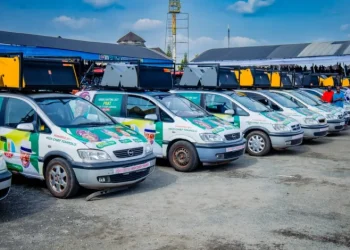


Electric vehicle (EV) manufacturers and marketers in Nigeria have accused government ministries, departments and agencies (MDAs) of applying double standards in implementing the Federal Government’s Nigeria First policy, alleging that public institutions continue to patronise foreign-made vehicles despite efforts to promote locally produced alternatives.
The policy is designed to prioritise Nigerian-made goods and locally assembled products in public procurement, creating opportunities for domestic manufacturers to expand production, attract investment and generate employment.
However, EV industry players argue that continued purchases of imported vehicles, including Chinese-made models, raise questions about the consistency of the policy’s implementation.
The concerns come as Nigerian EV businesses seek greater access to government contracts to strengthen local assembly operations and develop the country’s electric mobility industry.
One industry player, Orji, criticised what he described as a gap between the government’s policy commitments and the procurement decisions of public institutions.
“Our major concern is the double standards in government policy and the failure to practise what the government preaches,” Orji said.
He argued that while the Nigeria First policy encourages public institutions to patronise domestic producers, some government officials continue to use foreign-made vehicles and MDAs purchase imported alternatives.
“I do not think that makes sense,” he said.
Orji said government procurement could provide local EV manufacturers with a more dependable market, enabling them to expand production, attract investment and develop supporting infrastructure.
He called for financing arrangements that would make electric vehicles more affordable to drivers and fleet operators. He also advocated incentives for local assembly, technology transfer and job creation, alongside import-duty relief for essential manufacturing equipment and components.
According to him, increased private investment in charging stations, renewable energy and battery storage would further strengthen the sector.
Local manufacturers face import competition
Abuja-based EV marketer, Engr. Raheem Adebolu, also questioned how Nigerian manufacturers could compete with international producers operating under different cost conditions.
“The Chinese compete with local producers when they don’t have the same production costs like we do in Nigeria. How do they want us to compete?” Adebolu asked.
Domestic manufacturers face several cost pressures, including expenses associated with importing components, securing financing, establishing assembly facilities and developing after-sales service networks.
Abuja-based automotive technician Cyril Baros of Auto Mobility Services highlighted the advantages enjoyed by international manufacturers with established production systems and supply chains.
“Chinese automotive manufacturers operate in a market with substantial production capacity and established supply chains. Nigerian assemblers, by comparison, may face additional costs arising from infrastructure constraints, foreign exchange exposure and dependence on imported components,” Baros said.
These factors can influence vehicle prices and affect the ability of Nigerian businesses to compete for government procurement contracts.
Civil servants question availability of locally made EVs
During visits to selected MDAs, including offices at the Federal Secretariat in Abuja, Nairametrics sought to establish why foreign-made vehicles continue to feature in government procurement and how familiar officials are with locally assembled electric vehicles.
Some civil servants who spoke anonymously suggested that vehicle prices, availability and the production capacity of local manufacturers could influence procurement decisions.
A civil servant at the Federal Ministry of Health suggested that Chinese-made vehicles could be winning contracts because of their relatively lower prices compared with locally produced alternatives. The official expressed hope that Nigerian manufacturers would become more competitive as the domestic automotive industry develops.
Another civil servant, identified as Mr Muhammed, said he was unfamiliar with many Nigerian EV manufacturers and the vehicles they produce.
Nairametrics said it made several attempts to contact the National Automotive Design and Development Council (NADDC) for comment on the concerns raised by industry players, but had received no response as of the time of filing the report.
Government policies and EV transition
The dispute comes amid broader government efforts to encourage alternative-fuel vehicles, support local production and reduce transportation costs.
In May 2025, the Presidency announced plans to prevent MDAs from procuring foreign goods and services where locally produced alternatives were available.
In April 2026, the Federal Government announced an import-duty waiver covering electric vehicles, mass-transit buses and manufacturing machinery as part of measures intended to ease economic pressures and support investment.
While the waiver could reduce some costs for businesses importing vehicles and equipment, industry players argue that local manufacturers also require support to build production capacity and compete effectively.
In August 2026, President Bola Tinubu announced that state governors had agreed to leverage compressed natural gas (CNG) and electric vehicles to reduce transportation costs nationwide from October 1, 2026.
The initiative builds on the Presidential CNG Initiative launched in 2023 following the removal of the petrol subsidy.
Meanwhile, a proposed Electric Vehicle Transition and Green Mobility Bill, sponsored by Senator Orji Uzor Kalu, outlines measures intended to encourage local participation in the EV market.
The proposal includes provisions requiring foreign EV manufacturers to operate through registered local partnerships, establish assembly plants within three years of commencing operations and source at least 30 per cent of vehicle components locally by 2030.
It also outlines licensing requirements for manufacturers, importers, distributors and sellers, alongside penalties for certain violations. The bill’s current legislative status would need to be confirmed before its provisions can be treated as binding law.
Imported vehicles dominate market
The debate comes as Nigeria’s passenger motor car imports reportedly rose by 145.6 per cent year-on-year to N1.18 trillion in the first half of 2026, according to an earlier Nairametrics report.
The figures highlight the scale of demand for imported vehicles and the challenge facing domestic manufacturers seeking to capture a larger share of the market.
For Nigerian EV businesses, the central concern is whether government procurement rules, import incentives and local manufacturing policies will work together to build a competitive domestic industry.
Industry players say consistent implementation of the Nigeria First policy could help create demand for locally assembled vehicles, attract investment and support job creation. However, the extent to which local manufacturers can meet government requirements on pricing, supply, technology and reliability remains a key consideration.