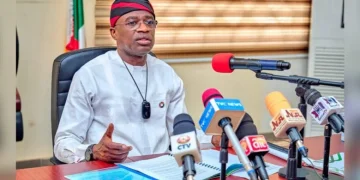


Benue State Governor Hyacinth Alia has cautioned FCT Minister Nyesom Wike against meddling in the state’s political affairs ahead of the 2027 elections, declaring that Benue would not replicate the political experience of Rivers State.
The governor’s Special Assistant on Social Media Communications, Asortar James Asortar, conveyed the warning, insisting that the state’s residents must independently determine their political leadership without interference from influential figures.
According to the aide, the governorship position should not be treated as a prize to be allocated through closed-door meetings or political deals among powerful individuals.
The remarks come amid reports about Wike’s Rainbow Coalition and its activities in Benue State as political calculations surrounding the forthcoming elections continue.
The situation has also drawn attention to the political relationship between Alia and prominent figures such as former governor Samuel Ortom and Secretary to the Government of the Federation, Senator George Akume.
Asortar urged Wike, Ortom and Akume to make the coalition’s agenda public and clarify whether the group intended to influence the selection of Benue’s next governor.
He maintained that any effort to determine the state’s leadership through informal agreements would undermine democratic participation. He added that political partnerships must not prevent citizens from exercising their right to choose their preferred candidates.
“Benue is not a political commodity, and its governorship is not for settlement in private political negotiations,” Asortar declared.
The aide also compared the situation in Benue with the prolonged political disagreement between Wike and Rivers State Governor Siminalayi Fubara.
Although Wike has left office as Rivers governor, he remains an influential participant in the state’s politics. His conflict with Fubara has triggered sustained disagreements over party leadership, loyalty and the control of political institutions.
Alia’s response indicates his unwillingness to allow external political interests to shape Benue’s leadership arrangements ahead of the next governorship election.
His representative argued that each state has its peculiar political circumstances and warned against attempts to reproduce strategies used elsewhere without considering Benue’s situation.
Asortar further stated that coalition leaders should openly outline their intentions if their objective was simply to bring political interests together. However, he demanded accountability if the alliance was designed to determine the outcome of the governorship contest.
The statement equally called on the All Progressives Congress (APC) and other political parties to safeguard internal democracy and ensure that members’ rights were respected.
It emphasised that the selection of candidates for the 2027 polls must comply with established party rules instead of being dictated by influential political personalities.
Defending Alia’s administration, the aide argued that the governor’s performance should be measured through tangible accomplishments and development efforts rather than the interests of political power brokers.
Among the projects highlighted were the rehabilitation of over 550 kilometres of roads and the development of more than 420 kilometres of additional road infrastructure.
The statement also pointed to initiatives aimed at settling outstanding salary liabilities inherited from the previous administration and improving the payment of workers’ salaries and pension benefits.
Alia’s camp maintained that decisions concerning Benue’s leadership must remain in the hands of its electorate, rather than being determined through private negotiations involving influential politicians.