

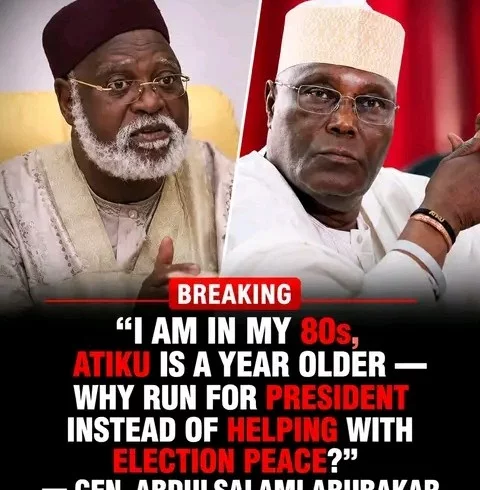
Abuja, August 25, 2026 — Former Head of State General Abdulsalami Abubakar (retd.) has openly questioned Atiku Abubakar’s decision to seek the presidency again in 2027, adding a fresh and unusually personal voice to the debate over age, zoning, and who should lead Nigeria next.
Speaking candidly, Abdulsalami — himself in his 80s and a year younger than Atiku — described the former vice president as a “very good friend” but said he could not ignore how demanding the presidency has become. He argued that Nigeria would be better served by leaders in their 50s and 60s who can match the pace of the job, rather than continuing to lean on candidates in their 70s and 80s.
Rather than another presidential run, Abdulsalami suggested Atiku could still serve the country meaningfully — for instance, through the National Peace Accord Committee, a body that has relied on elder statesmen to mediate political tensions around past elections. He was careful to acknowledge that Atiku retains the constitutional right to contest; his appeal was framed as advice from a friend, not a demand.
Abdulsalami’s intervention lands in the middle of a bigger, sharper argument that has been running for months: whether it is now the South’s turn to produce Nigeria’s president.
The Presidency has been blunt on this point. Presidential aide Bayo Onanuga has repeatedly insisted that the South must be allowed to complete its turn, arguing that President Bola Tinubu — like his predecessor Muhammadu Buhari — deserves two full terms before power rotates back to the North. Onanuga has accused Atiku of “self-serving” arithmetic, noting that Atiku made a similar case in 2023 when, as a PDP candidate, he contested to succeed a fellow northerner, a move Onanuga blames for splitting the party.
Atiku rejects that framing entirely. He argues zoning is not a binding national agreement but a PDP internal tradition that other parties have merely borrowed. By his own count, the South will have held the presidency for roughly 18 years since 1999 compared to about 10 for the North — a gap he says makes it hard to justify handing the South yet another term “under the guise of equity.” He has also pointed to 2011, when many of today’s zoning advocates backed Goodluck Jonathan’s southern presidency despite the North’s expectation of succeeding the late Umaru Yar’Adua.
What Abdulsalami’s comments add is a generational dimension that sits somewhat apart from the North-South argument: even some who are sympathetic to Atiku personally are asking whether Nigeria’s political class, north and south, needs to make room for younger candidates altogether.
Neither argument has settled anything yet. Atiku has said this would be his last run for the presidency, whatever happens. With the PDP having zoned its own 2027 ticket to the South and Atiku now positioning himself within the opposition African Democratic Congress (ADC), the coming months are likely to see the zoning and age debates continue to run side by side — each camp offering its own account of fairness, history, and who Nigeria needs next.