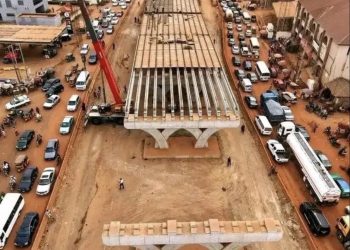
The Minister of Works, David Umahi, has declared that ongoing agitations for a separate Biafran state by some Igbo groups are no longer necessary, insisting that the federal government of President Bola Ahmed Tinubu has addressed long‑standing grievances through an inclusive governance approach. Umahi’s remarks came during an inspection tour of major road projects in the South‑East, where he made a passionate plea to Ndigbo (Igbo people) at home and in the diaspora to shelve calls for secession and instead embrace cooperation within a united Nigeria.
Speaking on Saturday during the assessment of ongoing works on the Enugu–Anambra Road, Minister Umahi argued that historical agitation for the creation of a Biafra nation was rooted in perceived marginalisation, neglect, and underrepresentation at the federal level. However, he maintained that under the Tinubu administration, the narrative has shifted significantly. “When a people are fully integrated, respected and empowered within the structure of the nation, the dream they once chased through agitation has already been achieved through cooperation,” Umahi said.
He pointed to what he described as unprecedented inclusion of Igbo professionals and political actors in the federal government as evidence of this shift. Umahi, who hails from the South‑East and serves as the Minister of Works, highlighted that Igbo appointments in key federal roles now reflect a more balanced representation of Nigeria’s diverse ethnic communities. He added that infrastructure development priorities have also begun to mirror this new inclusiveness, with significant capital projects emerging across all five states of the South‑East region.
“The President has deliberately opened the doors of national development to the South‑East. Appointments, policy inputs and infrastructure priorities now reflect true federal balance,” Umahi said, insisting that visible Igbo footprints in government contradict claims of marginalisation. He also cited the alignment of governors, such as Enugu State Governor Peter Mbah, with the All Progressives Congress (APC)‑led Federal Government as indicative of renewed confidence in the national leadership.
Umahi went further to assert that the agitation for Biafra had historically been misinterpreted by some as a desire to break away from Nigeria, when, in his view, what many Igbo people truly sought was representation, respect, and equity within the Nigerian federation. “Biafra was never about breaking Nigeria; it was about being counted in Nigeria,” he said. “Through inclusion, equity and concrete development, Ndigbo are no longer spectators in the Nigerian project; they are co‑authors of its future. When justice finds a people, agitation loses its voice.”
During the event, Umahi also reiterated his belief that the South‑East should wholeheartedly support President Tinubu, whom he credited with demonstrating “rare commitment” to the region’s development through targeted investments in infrastructure. In September, during another inspection — of the dualisation of the Enugu–Benue highway — Umahi had said the federal government had “remembered the South‑East,” remarks he has since reiterated as part of broader messaging about the administration’s policies in the region.
The minister’s comments echo official government positions that highlight President Tinubu’s efforts to promote national cohesion through strategic appointments and balanced development. Federal authorities have previously argued that inclusive governance is central to their agenda, claiming that political appointments and infrastructure projects have been designed to reflect Nigeria’s ethnic and regional diversity. Such remarks are part of a broader narrative by the administration aimed at calming ethnic tensions and promoting unity across the federation.
However, not all voices in the South‑East agree that marginalisation has been fully addressed. Some civil society groups and regional leaders continue to call for political solutions to contentious issues, including the detention of separatist figures and the removal of military checkpoints that have long been sources of tension for local communities. These calls highlight enduring concerns about trust, security, and equitable governance in the region.
As Nigeria heads into a period of heightened political activity, with elections, economic challenges, and pressing security issues on the national agenda, debates over federal inclusivity and regional representation are likely to remain central to public discourse. For now, the federal government continues to assert that its policies have significantly reduced the appeal of separatist sentiments by placing emphasis on unity, development, and inclusive governance — principles that Tinubu’s administration says will guide the country forward.


BREAKING: VDM Leads Protest at Ministry of Defence in Abuja Over Rising Insecurity
There was a significant turnout of Nigerians on Tuesday at the Ministry of Defence in Abuja as citizens joined...