

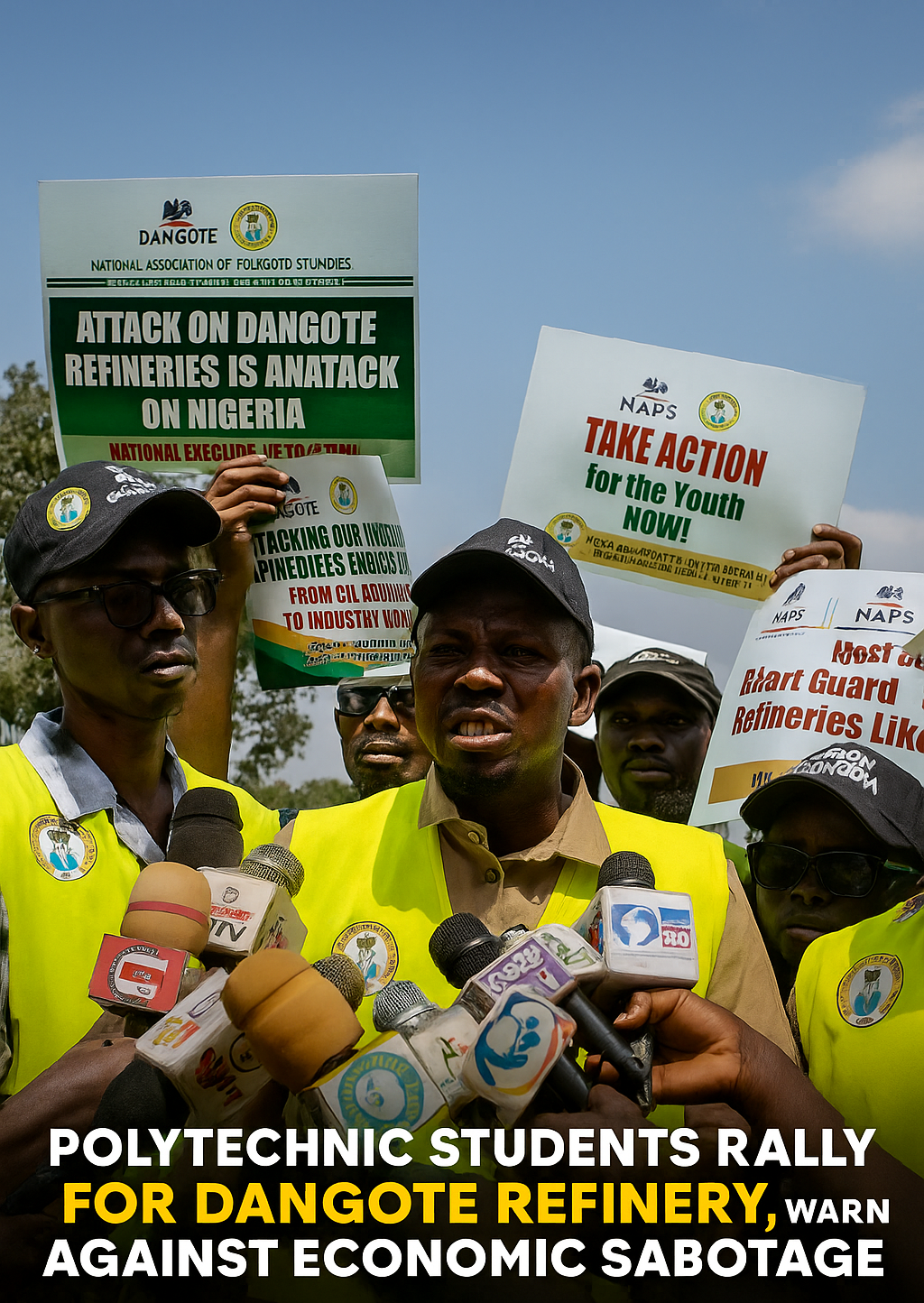
Hundreds of polytechnic and monotechnic students across Nigeria gathered in Abuja this week under the banner of the National Association of Polytechnic Students (NAPS) to express solidarity with the Dangote Refinery & Petrochemicals and to call on the federal government to shield the facility from what they described as “economic sabotage.”
Led by NAPS National President Eshiofune Paul Oghayan, the rally was themed “Protecting National Assets, Securing Youth Futures: NAPS Solidarity with Dangote Refinery for Economic Growth and Stability.” Participants carried placards bearing slogans such as “Attack on Dangote is an attack on Nigeria,” and “From Classroom to Industry, Nigerian Students Stand.”
Speaking at the event, Oghayan described the refinery as more than a fuel-processing facility, calling it “a living campus of industrial learning where Nigerian students are not merely spectators, but active participants in technological advancement.” He emphasized that thousands of young people stand to gain through the Students Industrial Work Experience Scheme (SIWES) placements and other training opportunities at Dangote’s associated industries.
He urged the government to ensure the refinery receives consistent crude supply, pointing out its current refining capacity of roughly 650,000 barrels per day with ambitions to scale to 1.4 million barrels per day. “When this facility operates fully, fuel prices will drop, job creation will rise, and Nigeria’s economy will gain sovereignty,” he said.
The rally also featured sharp criticism of certain labour unions and import-oriented interests, which students accused of deliberately undermining local refining initiatives to protect import-dependency models. “The forces that destroyed our public refineries are regrouping — not with guns, but with strikes, deceit, and blackmail,” Oghayan alleged, calling on government agencies to act firmly.
Officials from various security and regulatory bodies were present to provide support, with arrangements in place to maintain order and ensure the demonstration remained peaceful. The event concluded with a vote of confidence in the refinery and a public appeal for Nigerians to back locally refined fuel and national industrialization.
Analysts say the rally underscores growing youth interest in Nigeria’s industrial sector and a rising expectation that major investments — especially in oil and gas — should deliver tangible benefits such as jobs, training and economic transformation. The public backing of Dangote’s facility by NAPS reflects a broader youth-driven narrative seeking to link large-scale infrastructure to national development goals.
The federal government has previously acknowledged the refinery’s potential as a game changer for Nigeria’s downstream petroleum industry. But challenges remain: supply of feedstock, foreign currency exposures, labour relations, and coordination with regulatory agencies. The students’ rally amplifies calls for decisive action to protect large-scale domestic investment from policy uncertainty and internal obstruction.
In his closing remarks, Oghayan said: “This refinery is Nigeria’s future factories. We demand protection of national assets and an end to economic sabotage. The youth will not allow anyone destroy our hope for a self-reliant economy.”
As Nigeria seeks to deepen industrial capacity and reduce dependence on fuel imports, the students’ mobilisation signals a critical partnership between youth activism, private investment and public policy in the country’s economic reform agenda.