

President Bola Tinubu has declared that tackling the high cost of living remains a major priority of his administration, saying the government will focus on reducing the expenses involved in producing and moving goods and services across the country.
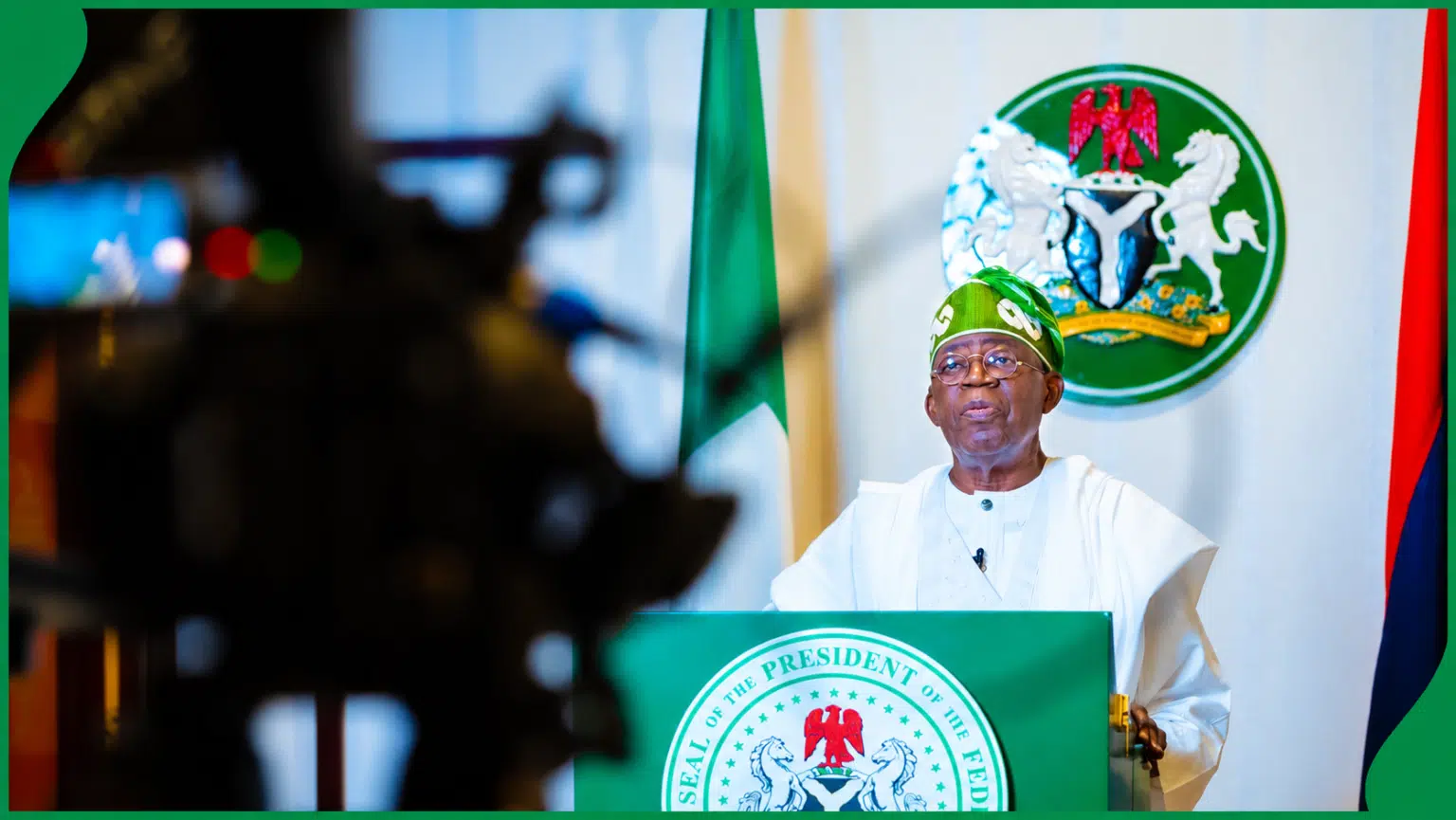
Tinubu made this known in his nationwide broadcast on Thursday to commemorate Nigeria’s 66th Independence anniversary. (Nigerian State House)
The President acknowledged that Nigeria had passed through several difficult periods since gaining independence, including civil war, military governments, economic downturns, insecurity and political crises. Despite these challenges, he said the country had remained together largely because of the determination and resilience of its people.
According to him, Nigeria’s founding vision was not limited to achieving political freedom. He said the country’s early leaders also envisaged a nation where citizens would have access to opportunities, dignity, freedom and improved living conditions.
Tinubu said the anniversary was therefore an appropriate moment to assess the decisions that had influenced Nigeria’s economic development over the years.
He argued that successive governments had repeatedly delayed difficult economic choices, allowing structural problems to become increasingly entrenched.
The President said his administration had spent the past three and a half years implementing reforms aimed at correcting those longstanding weaknesses. He maintained that the country was now moving beyond the period of economic adjustment and into a phase centred on growth and prosperity. (Channels TV)
Tinubu defended the reforms, saying they were introduced to address problems that existed before his government came into office. Using a medical analogy, he compared Nigeria’s economic challenges to a serious illness that required painful treatment rather than temporary relief.
He said previous administrations had relied on measures that eased immediate pressure without adequately addressing the underlying problems.
Tinubu insisted that his government had chosen to confront those issues directly, despite the difficulties Nigerians experienced during the adjustment period.
He also rejected suggestions that the government should abandon its reforms and return to subsidy arrangements, arguing that doing so would undermine the progress already recorded.
The President further claimed that Nigeria’s economy had begun showing signs of improvement. He cited economic growth of more than four per cent in 2026, contributions from both the petroleum and non-petroleum sectors, lower oil theft, a decline in inflation from its previous peak and improved stability in the foreign exchange market.
He also disclosed that non-oil exports generated more than $6 billion in 2025, describing the figure as the country’s highest-ever revenue from that source. (Nigerian State House)
Tinubu said the government’s next challenge was ensuring that economic gains were reflected in the daily lives of Nigerians.
He outlined plans to expand agricultural production, improve irrigation and mechanisation, strengthen storage facilities and develop roads, railways and ports to make the movement of goods cheaper.
He added that the administration would continue supporting businesses, expanding digital access, creating employment opportunities and improving access to education and consumer credit.
Tinubu said the ultimate objective was to build an economy where farmers could produce more efficiently, businesses could expand, young Nigerians could secure productive jobs and families could afford essential goods and services.
He acknowledged that many Nigerians were still struggling with food, school fees, healthcare and transportation costs but said the government would continue working to improve living conditions.
The President concluded by describing the reforms as the foundation for what he called a new era of shared prosperity, urging Nigerians to remain committed to building a stronger economy and a more prosperous country. (fmino.gov.ng)