

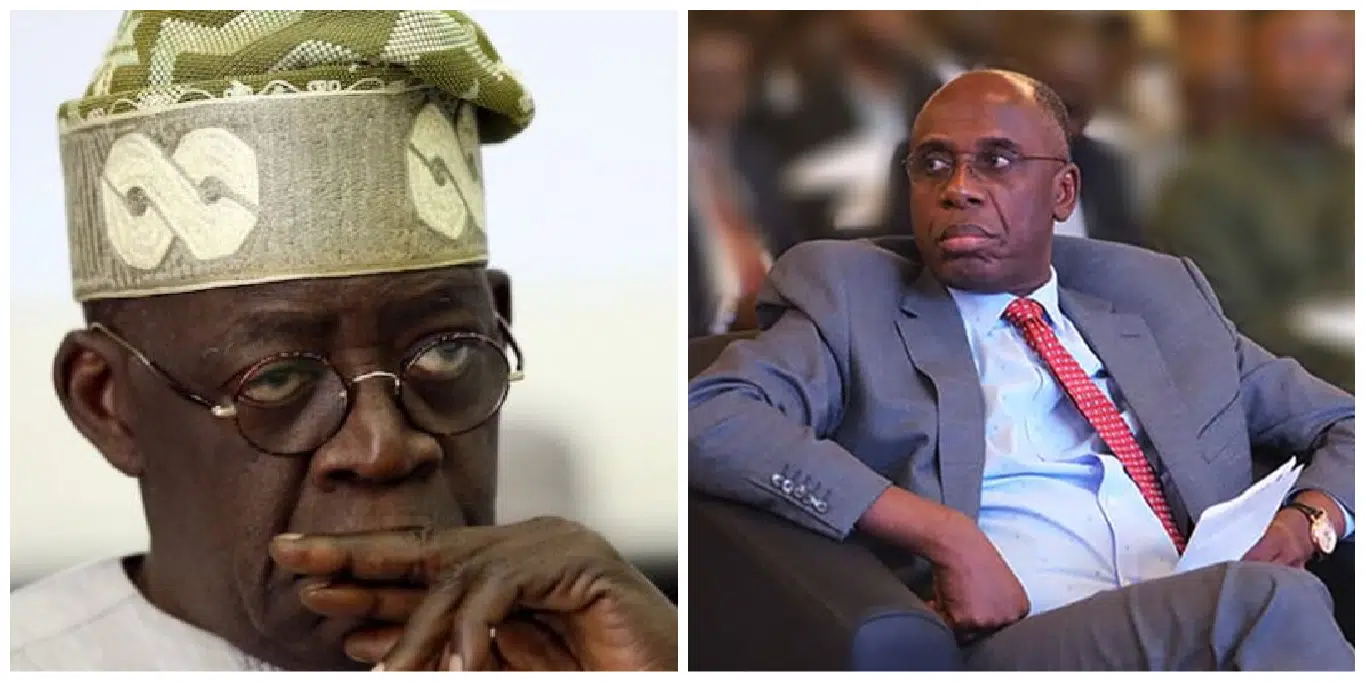
Former Minister of Transportation, Rotimi Amaechi, has argued that President Bola Tinubu is not Nigeria’s central challenge, insisting instead that the real problem lies in the weakness, division, and poor organisation of opposition parties.
Amaechi made this assertion on Thursday in Abuja during a joint press conference organised by leaders of several opposition groups. The briefing, themed “Urgent Call to Save Nigeria’s Democracy,” brought together notable political figures and stakeholders who expressed deep concern about the current state of the country’s democratic system.
Speaking frankly about the political environment, Amaechi said the opposition must take responsibility for its failures if it genuinely hopes to bring about meaningful change. According to him, blaming the ruling government alone is misguided when opposition parties themselves have failed to present a credible alternative.
“Tinubu is not our problem. The problem is the opposition. We are our own problem. When the opposition is ready, Nigeria will change,” he said.
He explained that the inability of opposition parties to unite, organise effectively, and offer a strong alternative vision has only strengthened the ruling party and weakened democratic accountability. Amaechi stressed that before seeking the trust of Nigerians, opposition groups must first clearly differentiate themselves from the government in power and show that they represent something truly different.
“The first thing we must know is that we must separate ourselves from the government in power. We must show the difference,” he stated.
Reflecting on his time in government under former President Muhammadu Buhari, Amaechi also spoke about alleged internal resistance to electoral reform. He claimed that although Buhari was initially willing to pursue reforms, some ministers persuaded him not to sign key proposals, using fear-based arguments about foreign interference.
“When I was in government during Buhari’s time, he wanted electoral reform. A few ministers went to him and convinced him not to sign, saying that if he signed, Russia would hack the system and impose the wrong president on us, and he refused to sign,” Amaechi revealed.
He added pointedly that many of those who blocked reforms in the past are now among the loudest voices calling for electoral change, suggesting hypocrisy and political opportunism.
Amaechi further argued that Tinubu’s confidence is rooted in what he described as a fragmented and ineffective opposition. According to him, the President’s strategy is simple: test the opposition with small actions, and when there is no strong response, escalate further.
“His strategy is simple. He’s trying something today, you are weak. He puts something bigger, you are weaker,” he said.
He also questioned what he described as the President’s boldness in the face of criticism, noting that the absence of a strong opposition response encourages political indifference and confidence.
Ultimately, Amaechi maintained that real political change will only occur when the opposition becomes united, organised, and capable of decisive action. He urged opposition leaders to rebuild public confidence, develop a clear identity, and present a strong, credible challenge to the ruling party ahead of the 2027 general elections.
Amaechi concluded that meaningful political transformation in Nigeria can only happen if opposition parties overcome their divisions and rebuild themselves into a disciplined, coordinated, and action-driven force. He called on opposition leaders to restore public trust, redefine their political direction, and offer Nigerians a clear and credible alternative to the ruling party as the country moves toward the 2027 general elections.