

The Independent Corrupt Practices and Other Related Offences Commission (ICPC) has absolved the Chief of Staff to President Bola Tinubu, Femi Gbajabiamila, of any wrongdoing in the controversial Presidential Foreign Investment Promotion Council (PFIPC) saga.
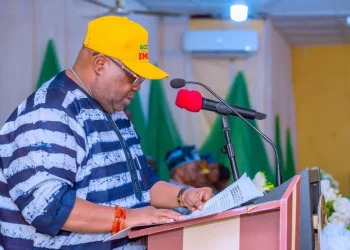
The anti-graft agency disclosed that the purported Director-General of the PFIPC, Prince Adeniyi Adeyemi, was never appointed by the Federal Government and that the appointment letter he presented was forged.
The ICPC also established that the PFIPC was a fictitious organisation created without any legal backing.
The commission further revealed that Adeyemi, who is currently in custody, allegedly established two other fictitious government agencies, unlawfully occupied the former office of the Presidential Economic Advisory Council (PEAC), and exploited weaknesses in government verification systems, allegedly with the negligence or connivance of some public officials.
ICPC Chairman, Dr Musa Aliyu (SAN), disclosed the findings while briefing journalists after submitting the commission’s interim investigation report to President Bola Tinubu at the State House in Abuja.
President Tinubu had on July 7 directed the ICPC to investigate allegations by Adeyemi that he paid N400 million to Gbajabiamila to secure his appointment as Director-General of the purported PFIPC. The commission was given 30 days to complete the investigation and submit its findings.
Aliyu said the investigation established that Adeyemi was never appointed by the Federal Government or any government authority, while the PFIPC was never established by any law, executive order or other valid government instrument.
He said the appointment letter presented by Adeyemi was forged, alongside other documents allegedly used to give the fake agency an appearance of legitimacy.
The ICPC chairman added that the fictitious organisation relied on a forged gazette and other fabricated legal documents to support its operations.
Aliyu also disclosed that investigators found that Adeyemi unlawfully took over the former offices of the Presidential Economic Advisory Council after allegedly breaking into the premises.
According to him, the suspect subsequently used the office to engage in impersonation, false representation and other illegal activities.
The ICPC chairman said the investigation also uncovered significant weaknesses in government verification processes and inter-agency coordination, which allegedly enabled the scheme to operate.
“Our interim report found weaknesses in verification, inter-agency oversight and government processes. Those weaknesses were exploited by Adeniyi Adeyemi Matthew with some level of negligence and connivance,” he said.
However, Aliyu clarified that investigators found no evidence that federal government funds were approved or disbursed to the fake PFIPC or PEAC.
He also said the investigation found no systemic weaknesses in the State House or the Central Bank of Nigeria (CBN), adding that the forged appointment letter did not originate from the Presidency.
The ICPC further disclosed that Adeyemi allegedly created two other fictitious agencies — the FCT Investment Promotion Agency and the Foreign Investment Promotion Agency and Public Private Partnership.
The commission also said he changed the name of the PFIPC to the Presidential Foreign Intervention Promotion Council, apparently to broaden its purported mandate and encroach on the responsibilities of legitimate government institutions.
According to Aliyu, investigators identified public officials whose alleged negligence or omissions facilitated the activities of the fake agency.
Officials linked to the Office of the Secretary to the Government of the Federation, the Office of the Head of the Civil Service of the Federation, the Office of the Accountant-General of the Federation, the Budget Office and the National Information Technology Development Agency (NITDA) were identified during the investigation.
The ICPC recommended the prosecution of Adeyemi, administrative sanctions against public officials whose negligence facilitated the activities of the fake agency, and institutional reforms to strengthen internal controls across Ministries, Departments and Agencies.
Aliyu said the commission also recommended measures to prevent similar incidents in the future.
Meanwhile, the Special Adviser to the President on Media and Public Communications, Sunday Dare, said President Tinubu would study the interim report and consult the Attorney-General of the Federation before determining the next course of action.
Dare said the President directed that the findings be made public in the interest of transparency, while investigations by the National Assembly, the Nigeria Police Force and other relevant agencies would complement the process.
Meanwhile, the Corps Marshal of the Federal Road Safety Corps (FRSC), Shehu Mohammed, told the House of Representatives Ad Hoc Committee investigating the matter that President Tinubu was listed as Chairman of the Governing Board of the fake agency on its website.
He said the website also listed the Secretary to the Government of the Federation, the Head of the Civil Service of the Federation, the Governor of the Central Bank of Nigeria, the Attorney-General of the Federation and several ministers as members of the purported governing board.
Mohammed explained that the fake website, combined with what appeared to be genuine government correspondence and successful verification of statutory payments through the REMITA platform, misled the FRSC into issuing official number plates to seven vehicles belonging to the organisation.
According to him, the requests were submitted using what appeared to be official letterhead of a federal government agency, while Adeyemi personally delivered the documents and presented himself as the Director-General.
He added that the FRSC also visited the website referenced in the correspondence, which used a federal government domain and contained information that appeared consistent with that of a legitimate government institution.
The Corps Marshal admitted shortcomings in the FRSC’s verification process, describing the incident as an isolated case. He said the agency had commenced efforts to recover all official number plates issued to the fake organisation and was strengthening its internal verification procedures.
However, Chairman of the House Ad Hoc Committee, Hon. Yusuf Gagdi, faulted the FRSC for failing to detect what he described as glaring irregularities in the documents submitted by Adeyemi.
Gagdi noted that it was unusual for the President to serve as chairman of the governing board of such an organisation alongside virtually all key federal officials.
Documents tendered before the committee showed that seven vehicles approved for registration included a 2024 black Lexus LX armoured vehicle, two 2024 Toyota Land Cruiser models, a Toyota Hilux GR and three Toyota Hilux Adventure vehicles.
Mohammed maintained that the chassis numbers of all seven vehicles were physically verified and matched the respective vehicles before the official federal government number plates were issued.