

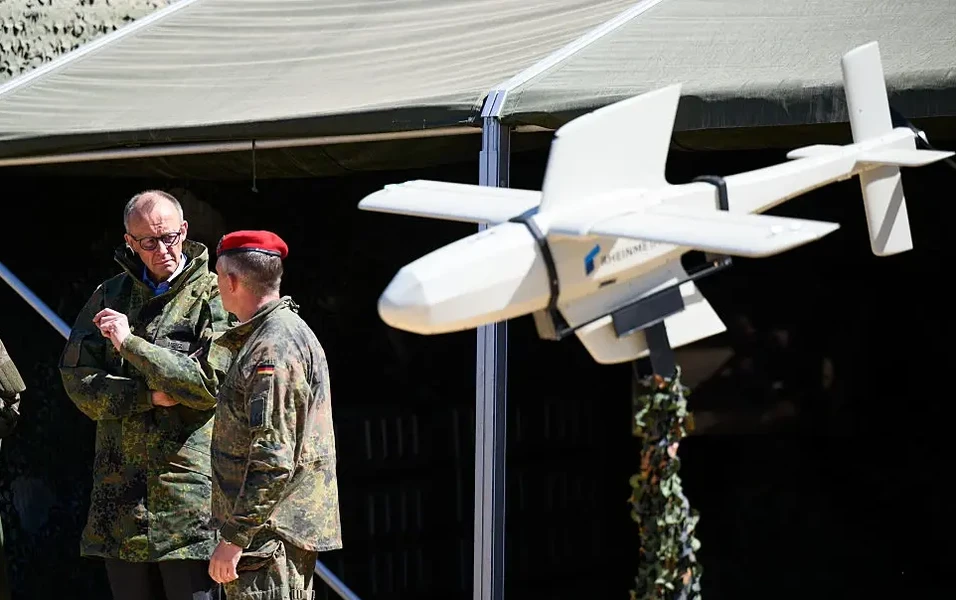
German authorities have launched a counterterrorism investigation after an explosive-laden drone was discovered near a Ukrainian cargo aircraft at Leipzig/Halle Airport, prompting heightened security concerns over what officials describe as a potential new form of hybrid attack.
The drone was found late Tuesday in a restricted cargo area near the airport’s southern runway, one of Europe’s busiest cargo hubs. The discovery led to the temporary suspension of flight operations, with several aircraft diverted to other airports.
By Wednesday morning, airport authorities had reopened one runway and resumed most operations, while the southern runway remained closed as bomb disposal experts examined the device and safely removed its detonator.
Speaking after an emergency meeting with Germany’s security chiefs on Wednesday evening, Interior Minister Alexander Dobrindt described the incident as a “new threat scenario.”
“Drone sightings and drone threats in a hybrid context are something we have known from the past, but a drone armed with explosives being present on airport grounds is a new threat scenario,” Dobrindt said.
Earlier on Wednesday, German police confirmed they had responded to a suspicious object discovered near one of the airport’s runways following what officials described as an overnight security incident.
The Bild newspaper reported that the drone was found close to a Ukrainian Antonov cargo aircraft. Antonov has operated from Leipzig/Halle Airport since relocating part of its operations there following Russia’s full-scale invasion of Ukraine in 2022.
Authorities stressed that there was no immediate danger to passengers or airport personnel during the incident.
Cargo Aircraft Also Reports Mid-Air Collision
In a separate development, a DHL cargo aircraft reportedly collided with an unidentified object shortly after taking off from Leipzig/Halle Airport.
According to a source cited by Reuters, the aircraft made a precautionary diversion and landed safely in Hanover, where inspectors later found minor damage to the aircraft.
Investigators are now examining whether the two incidents are connected.
Investigation Underway
German authorities have not identified those responsible for the incident.
Dobrindt said determining the origin of the drone would form a key part of the ongoing investigation, noting that hybrid threats are often deliberately designed to conceal those behind them.
“Such threat situations are not carried out by amateurs but must be prepared and executed very professionally,” he said.
Anti-extremism prosecutors and specialist counterterrorism investigators have assumed responsibility for the case after experts confirmed that the drone contained explosives.
Suspicion Falls on Russia
Although German authorities have not publicly blamed any country, Ukraine’s Ambassador to Germany, Oleksii Makeiev, accused Russia of being responsible.
“Who else could it be but Russia?” the ambassador told Germany’s Welt TV.
Russia has not commented on the latest incident.
The discovery comes amid growing concerns over suspected sabotage operations across Europe.
German airports have experienced a series of unauthorised drone incursions in recent months, including over military installations, energy facilities, seaports and logistics centres. German federal police have previously suggested that some of those overflights may have been organised by Russian agents.
European security agencies are also continuing investigations into a series of parcel fires in 2024 involving incendiary devices concealed in cargo shipments, incidents that raised concerns about possible sabotage targeting air freight operations.
Moscow has consistently denied involvement in both the earlier parcel incidents and the suspected drone overflights.
A NATO official told The Guardian that the alliance was aware of the latest incident and was closely monitoring the investigation being conducted by German authorities.
The incident has intensified concerns over the growing use of drones in suspected hybrid warfare, with security officials warning that attacks targeting critical infrastructure are becoming increasingly sophisticated and difficult to prevent.