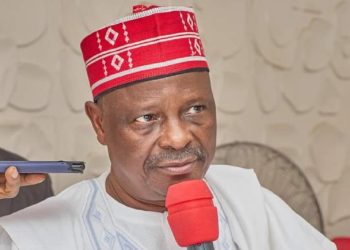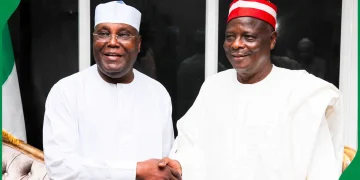


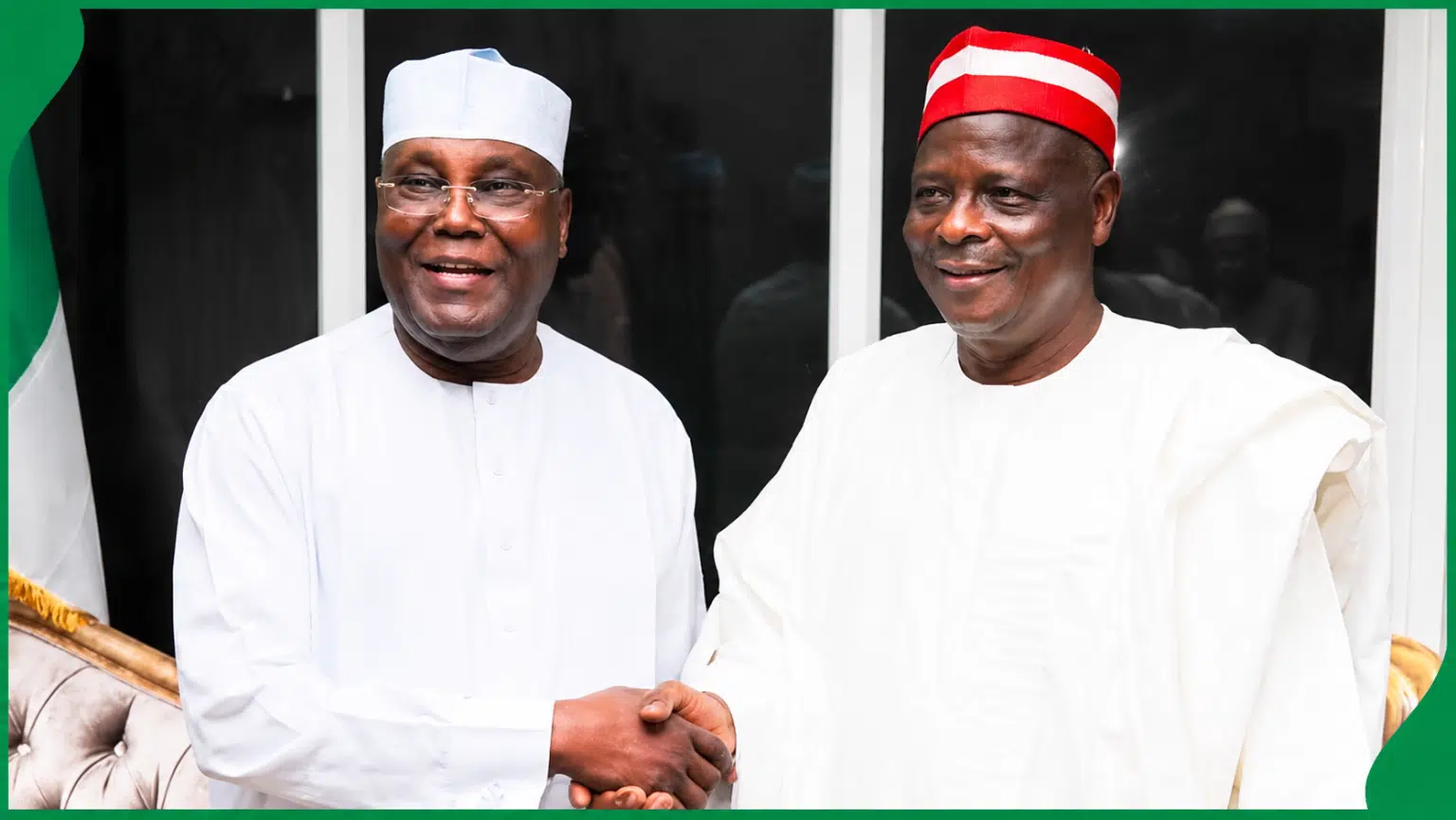
The African Democratic Congress (ADC) Presidential Campaign Council has lashed out at Rabiu Kwankwaso, the Nigeria Democratic Congress (NDC) deputy presidential candidate, following his suggestion that former Vice President Atiku Abubakar should relinquish his ambition to contest the 2027 presidential election.
Naija News reports that Kwankwaso made the appeal during a conversation with Channels Television, revealing that he had urged some Fulani associations to convince Atiku to pull out of the presidential contest.
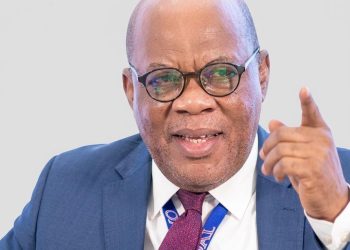
In response, Kola Ologbondiyan, the ADC-PCC Director of Media and Publicity, denounced the proposal, describing it as a calculated move allegedly designed to protect President Bola Tinubu’s political fortunes ahead of the forthcoming election.
Ologbondiyan questioned Kwankwaso’s dedication to the opposition’s campaign to dislodge Tinubu and the All Progressives Congress (APC) from government in 2027.
He equally expressed doubts about Kwankwaso’s allegiance to Peter Obi, suggesting that his decision to support the former Anambra governor was motivated by his own political aspirations rather than a collective determination to defeat the ruling party.
The ADC campaign council argued that Kwankwaso was directing his attacks at Atiku instead of concentrating on challenging Tinubu’s administration, which the opposition hopes to defeat at the polls.
Ologbondiyan maintained that Atiku remained a formidable opposition contender whose experience and nationwide political connections could help him attract support across the country.
He further alleged that Kwankwaso’s insistence that Atiku withdraw from the race could trigger unnecessary friction among opposition leaders and undermine their efforts to challenge the APC.
According to the ADC spokesperson, the development appeared consistent with what he described as a strategy of exploiting disagreements within opposition ranks to improve the ruling party’s political prospects.
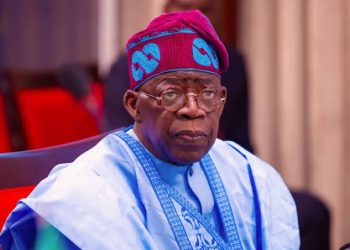
In the statement, the council said Kwankwaso’s demand was an attempt to promote Tinubu’s interests rather than strengthen the opposition’s chances in the forthcoming presidential election.
Ologbondiyan also accused the former Kano State governor of placing excessive emphasis on Atiku’s candidacy while failing to direct comparable attention towards mobilising against the incumbent president.
He maintained that Nigerians were increasingly concerned about the economic conditions in the country and that opposition politicians should focus on presenting an alternative to the current administration.
The ADC campaign council also challenged Kwankwaso’s assessment of his political relevance, arguing that his influence should be measured against his performance in previous nationwide elections.
Ologbondiyan pointed to Kwankwaso’s fourth-place finish in the 2023 presidential poll, questioning whether his political following was sufficient to secure victory in a contest involving candidates with broader national reach.
He insisted that popularity within particular political constituencies should not automatically be interpreted as an ability to win the presidency.
Defending Atiku’s political credentials, the ADC spokesperson described the former vice president as an experienced politician whose relationships extended across Nigeria’s various regions.
He noted that Atiku had spent over three decades building political alliances and maintaining connections across the North, South, East and West, which the campaign council considers an advantage in a nationwide election.
The council subsequently appealed to Kwankwaso and his associates to reconsider their position and lend their support to Atiku instead of promoting calls for his withdrawal.
Ologbondiyan maintained that the ADC considered Atiku its preferred option for challenging Tinubu’s re-election bid, arguing that a change in government was necessary to address the country’s economic difficulties.
He concluded that the opposition’s priority should be tackling rising living costs, widespread poverty and insecurity, which the council attributed to the policies and performance of the APC-led administration.